
A New Ice Age Reading Answers with Explanation
Many test takers do not have perfect guidance to perform better in the IELTS reading section. If you are in one of them and having trouble particularly for preparing the segment, this write-up is for you. By solving the write-up of a new ice age reading answers with detailed explanations, you can well prepare for IELTS test. Students who have not proper resources can practice with this sample write-up. You will have a better idea of how you will get questions in the exam if start rehearsing the passage. This is a better chance to challenge yourself and move closer to your high scores.
Generally, in the reading section, students get 60 minutes to complete three types of reading passages. Test takers have to solve each of them within 20 minutes with the right answers. If you want to attempt all the tasks within the time frame, you have to manage accordingly. So, explore the write-up of a new ice age and practice for the exam.
IELTS Prep Boost
Elevate your preparation with exclusive tools
Unlimited Access Includes
BEST PLANDuration Days
IELTS Reading Passage - A New Ice Age Reading Answers
Paragraph- A
William Curry is a serious, sober climate scientist, not an art critic. But he has spent a lot of time perusing Emanuel Gottlieb Leutze’s famous painting “George Washington Crossing the Delaware”, which depicts a boatload of colonial American soldiers making their way to attack English and Hessian troops the day after Christmas in 1776. “Most people think these other guys in the boat are rowing, but they are actually pushing the ice away,” says Curry, tapping his finger on a reproduction of the painting. Sure enough, the lead oarsman is bashing the frozen river with his boot. “I grew up in Philadelphia. The place in this painting is 30 minutes away by car. I can tell you, this kind of thing just doesn’t happen anymore.”
Paragraph- B
But it may happen again soon. Ice-choked scenes, similar to those immortalized by the 16th-century Flemish painter Pieter Brueghel the Elder, may also return to Europe. His works, including the 1565 masterpiece “Hunters in the Snow”, make the now-temperate European landscapes look more like Lapland. Such frigid settings were commonplace during a period dating roughly from 1300 to 1850 because much of North America and Europe was in the throes of a little ice age. And now there is mounting evidence that the chill could return. A growing number of scientists believe conditions are ripe for another prolonged cooldown, or small ice age. While no one is predicting a brutal ice sheet like the one that covered the Northern Hemisphere with glaciers about 12,000 years ago, the next cooling trend could drop average temperatures 5 degrees Fahrenheit over much of the United States and 10 degrees in the Northeast, northern Europe, and northern Asia.
Paragraph- C
“It could happen in 10 years,” says Terrence Joyce, who chairs the Woods Hole Physical Oceanography Department. “Once it does, it can take hundreds of years to reverse.” And he is alarmed that Americans have yet to take the threat seriously.
Paragraph- D
A drop of 5 to 10 degrees entails much more than simply bumping up the thermostat and carrying on. Both economically and ecologically, such quick, persistent chilling could have devastating consequences. A 2002 report titled “Abrupt Climate Change: Inevitable Surprises”, produced by the National Academy of Sciences, pegged the cost from agricultural losses alone at $100 billion to $250 billion while also predicting that damage to ecologies could be vast and incalculable. A grim sampler: disappearing forests, increased housing expenses, dwindling fresh water, lower crop yields, and accelerated species extinctions.
Paragraph- E
The reason for such huge effects is simple. A quick climate change wreaks far more disruption than a slow one. People, animals, plants, and the economies that depend on them are like rivers; says the report: "For example, high water in a river will pose few problems until the water runs over the bank, after which levees can be breached and massive flooding can occur. Many biological processes undergo shifts at particular thresholds of temperature and precipitation.”
Paragraph- F
Political changes since the last ice age could make survival far more difficult for the world's poor. During previous cooling periods, whole tribes simply picked up and moved south, but that option doesn't work in the modern, tense world of closed borders. "To the extent that abrupt climate change may cause rapid and extensive changes of fortune for those who live off the land, the inability to migrate may remove one of the major safety nets for distressed people,” says the report.
Paragraph- G
But first things first. Isn't the earth actually warming? Indeed it is, says Joyce. ‘In his cluttered office, full of soft light from the foggy Cape Cod morning, he explains how such warming could actually be the surprising culprit of the next mini-ice age. The paradox is a result of the appearance over the past 30 years in the North Atlantic of huge rivers of fresh water - the equivalent of a 10-foot-thick layer - mixed into the salty sea. No one is certain where the fresh torrents are coming from, but a prime suspect is melting Arctic ice, caused by a build-up of carbon dioxide in the atmosphere that traps solar energy.
Paragraph- H
The freshwater trend is major news in ocean science circles. Bob Dickson, a British oceanographer who sounded an alarm at a February conference in Honolulu, has termed the drop in salinity and temperature in the Labrador Sea - a body of water between northeastern Canada and Greenland that adjoins the Atlantic - "arguably the largest full-depth changes observed in the modern instrumental oceanographic record”.
Paragraph- I
The trend could cause a little ice age by subverting the northern penetration of Gulf Stream waters. Normally, the Gulf Stream, laden with heat soaked up in the tropics, meanders up the east coasts of the United States and Canada. As it flows northward, the stream surrenders heat to the air. Because the prevailing North Atlantic winds blow eastward, a lot of the heat wafts to Europe, that’s why many scientists believe winter temperatures on the Continent are as much as 36 degrees Fahrenheit warmer than those in North America at the same latitude. Frigid Boston, for example, lies at almost precisely the same latitude as balmy Rome. And some scientists say the heat also warms Americans and Canadians. “It’s a real mistake to think of this solely as a European phenomenon," says Joyce.
Paragraph- J
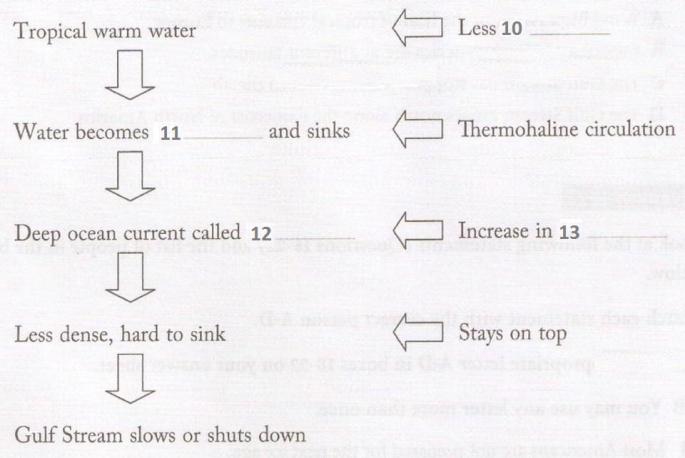
Having given up its heat to the air, the now-cooler water becomes denser and sinks into the North Atlantic by a mile or more in a process oceanographers call thermohaline circulation. This massive column of cascading cold is the main engine powering a deep-water current called the Great Ocean Conveyor that snakes through all the world’s oceans. But as the North Atlantic fills with fresh water, it grows less dense, making the waters carried northward by the Gulf Stream less able to sink. The new mass of relatively fresh water sits on top of the ocean like a big thermal blanket, threatening the thermohaline circulation. That in turn could make the Gulf Stream slow or veer southward. At some point, the whole system could simply shut down and do so quickly. “There is increasing evidence that we are getting closer to a transition point, from which we can jump to a new state.”
Questions for Reading Passage: A New Ice Age
Questions 1-4
Choose the correct letter A, B, C, or D.
Write your answers in boxes 1-4 on your answer sheet.
1. The writer uses paintings in the first paragraph to illustrate
a) possible future climate change.
b) climate change of the last two centuries.
c) the river doesn’t freeze in winter anymore.
d) how George Washington led his troops across the river.
2. Which of the following do scientists believe to be possible?
a) The temperature may drop over much of the Northern Hemisphere.
b) It will be colder than 12,000 years ago.
c) The entire Northern Hemisphere will be covered in ice.
d) Europe will look more like Lapland.
3. Why is it difficult for the poor to survive the next ice age?
a) People don’t live in tribes anymore.
b) Politics are changing too fast today.
c) Abrupt climate change causes people to live off their land.
d) Migration has become impossible because of closed borders.
4. Why is continental Europe much warmer than North America in winter?
a) Wind blows most of the heat of tropical currents to Europe.
b) Europe and North America are at different latitudes.
c) The Gulf Stream has stopped yielding heat to the air.
d) The Gulf Stream moves north along the east coast of North America.
Questions 5-9
Look at the following statements (Questions 5-9) and the list of people in the box below.
Match each statement with the correct person A-D.
Text Box: Write the appropriate letter A-D in boxes 5-9 on your answer sheet.
NB You may use any letter more than once.
5. Most Americans are not prepared for the next ice age.
6. The result of abrupt climate change is catastrophic.
7. The world is not as cold as it used to be.
8. Global warming is closely connected to the ice age.
9. Alerted people to the change of ocean water in a conference
| List of People I.William Curry II.Terrence Joyce III.Bob Dickson IV. National Academy of Sciences |
Questions 10-13
Complete the flow chart below.
Choose NO MORE THAN THREE WORDS from the passage for each answer.
Write your answers in boxes 10-13 on your answer sheet.
Premium IELTS Coaching
at an Affordable Price
Answers of A New Ice Age Reading Passage with Explanation
For some test takers, identifying correct answers from the passage can be tricky. From the following section, you can learn how to locate the solutions within a time duration. So, let’s explore a new ice age reading answers with detailed explanations.
Question 1
Question 2
Question 3

Unlock All Explanations for Free
Question 4
Question 5
Question 6
Question 7
Question 8
Question 9
Question 10
Question 11
Question 12
Question 13

IELTS Prep Boost
Unlimited Access Includes
Other Passages
Important Links for IELTS Exam
Explore Free IELTS Mock Tests
Find IELTS Coaching Centres
Practice Every IELTS Module
Essential IELTS Tools & Resources
Study Abroad Consultants in India
Top Study Abroad Destinations
Exams Required to Study Abroad
Popular Universities to Study Abroad
Important Links for IELTS Exam
Explore Free IELTS Mock Tests
Find IELTS Coaching Centres
Practice Every IELTS Module
Essential IELTS Tools & Resources
Study Abroad Consultants in India
Top Study Abroad Destinations
Popular Universities to Study Abroad
Quick Links
The above passage is about William Curry who is a serious and sober climate scientist. He was brought up in Philadelphia, 30 minutes away from the painting. He spent a lot of time perusing Emanuel Gottlieb Leutze’s famous painting, which indicates a boatload of colonial American soldiers making a route to attack English and Hessian troops. The name of the painting is “George Washington Crossing the Delaware.” Few people have the perception that these other guys in the boat are arguing, but they are pushing back the ice away. In this passage, you will also read about the reasons for climate change and affection for global warming. Now, you have an idea of the write-up, a new ice age reading answers. From this, you can prepare for your IELTS reading section and will know the exact pattern of the exam.
However, for some students, it might be typical to gather proper study material to for prepare their exam. But you do not need to worry because you have guidance from Gradding.com. Here, you can start your practice with a skilled trainer’s assistance. Also, they will teach you different ways to attempt your exam without facing issues.
Tips for Acing a New Ice Age Reading Answers
Proper guidance to improve reading skills is necessary for every candidate. However, specifically for new ice age reading answers, a few strategies are provided below. Further, read them and implement them in your practice.
- Candidates can take online vocabulary quizzes to assess their current level and improve their skills in learning new words.
- You can take an IELTS reading mock test to practice with real exam-level questions. This will help you identify the structure of the tasks for better clarity.
- Remember, whenever you read any passage or text, use skimming and scanning techniques to know the main idea of the content. From this, you can easily find answers to questions.
Types of Questions in This Reading Passage
To know how you can solve a new ice age reading answers, you have to learn about the types of questions. So, let’s discuss each task in detail for better clarity.
Multiple Choice Questions
In the passage, there are some multiple-choice questions given. To solve each task you have to choose the correct answer from the provided list. Typically, you get three or four options to select any one accurately. You have to carefully read the question and find the relevant information from the passage.
Matching Features
Matching features are types of questions where you get a list of phrases or sentences with related items. In this, you have to identify the task and find the information from the given passage. After that, candidates need to match those options from the other list. These can be found in specific numbers, names, places, or anything.
Flow Chart Completion
In the IELTS reading section, flow chart completion is a type of question where you have to fill in the missing blanks after finding proper details from the passage. Here, you get a sequence of events, processes, or steps which is logically related to each other. It can be given in words or phrases, and you have to find correct answers from the text.
Conclusion
Finally, you have an idea of IELTS reading section tasks from a New Ice Age reading answers write-up. Surely, this will be helpful for your exam preparation. If students want to crack this test with good scores, they must use several ways, and one of the best is online IELTS coaching. To guide you throughout your exam days, Gradding.com provides you with this opportunity. In this, you will be taught by the most skilled teachers in classes. However, if you want to get high scores in this section, no one can better guide you, instead of them.
