
A Remarkable Beetle Reading Answers with Explanations
IELTS is a language proficiency test that assesses your English skill abilities. To get good scores you have to focus on all sections Listening, Speaking, Writing and Speaking. However, the reading part needs the most attention as it evaluates the language of the student in reading skills and ability to understand the test.
However, from this page, you will get the solutions to questions for “A Remarkable Beetle” Reading Answers. It will help you to boost your reading skills. The ideal time to solve all the passage questions is approx 20 minutes. So, let’s see if you can solve all of them and understand the text within the desired time.
IELTS Prep Boost
Elevate your preparation with exclusive tools
Unlimited Access Includes
BEST PLANDuration Days
IELTS Reading Passage- A Remarkable Beetle
More than 4,000 species of these remarkable creatures have evolved and adapted to the world’s different climates and the dung of its many animals. Australia’s native dung beetles are scrub and woodland dwellers, specialising in coarse marsupial droppings and avoiding the soft cattle dung in which bush flies and buffalo flies breed.Some of the most remarkable beetles are the dung beetles, which spend almost their whole lives eating and breeding in dung’.
In the early 1960s George Bornemissza, then a scientist at the Australian Government’s premier research organisation, the Commonwealth Scientific and Industrial Research Organisation (CSIRO), suggested that dung beetles should be introduced to Australia to control dung-breeding flies. Between 1968 and 1982, the CSIRO imported insects from about 50 different species of dung beetle, from Asia, Europe and Africa, aiming to match them to different climatic zones in Australia. Of the 26 species that are known to have become successfully integrated into the local environment, only one, an African species released in northern Australia, has reached its natural boundary.
Introducing dung beetles into a pasture is a simple process: approximately 1,500 beetles are released, a handful at a time, into fresh cow pats2 in the cow pasture.
The beetles immediately disappear beneath the pats digging and tunnelling and, if they successfully adapt to their new environment, soon become a permanent, self sustaining part of the local ecology. In time they multiply and within three or four years the benefits to the pasture are obvious.
Dung beetles work from the inside of the pat so they are sheltered from predators such as birds and foxes. Most species burrow into the soil and bury dung in tunnels directly underneath the pats, which are hollowed out from within. Some large species originating from France excavate tunnels to a depth of approximately 30 cm below the dung pat. These beetles make sausage-shaped brood chambers along the tunnels. The shallowest tunnels belong to a much smaller Spanish species that buries dung in chambers that hang like fruit from the branches of a pear tree. South African beetles dig narrow tunnels of approximately 20 cm below the surface of the pat. Some surface-dwelling beetles, including a South African species, cut perfectly-shaped balls from the pat, which are rolled away and attached to the bases of plants.
For maximum dung burial in spring, summer and autumn, farmers require a variety of species with overlapping periods of activity. In the cooler environments of the state of Victoria, the large French species (2.5 cms long) is matched with smaller (half this size), temperate-climate Spanish species. The former are slow to recover from the winter cold and produce only one or two generations of offspring from late spring until autumn. The latter, which multiply rapidly in early spring, produce two to five generations annually. The South African ball-rolling species, being a subtropical beetle, prefers the climate of northern and coastal New South Wales where it commonly works with the South African tunnelling species. In warmer climates, many species are active for longer periods of the year.
Dung beetles were initially introduced in the late 1960s with a view to controlling buffalo flies by removing the dung within a day or two and so preventing flies from breeding. However, other benefits have become evident. Once the beetle larvae have finished pupation, the residue is a first-rate source of fertiliser. The tunnels abandoned by the beetles provide excellent aeration and water channels for root systems. In addition, when the new generation of beetles has left the nest the abandoned burrows are an attractive habitat for soil-enriching earthworms. The digested dung in these burrows is an excellent food supply for the earthworms, which decompose it further to provide essential soil nutrients. If it were not for the dung beetle, chemical fertiliser and dung would be washed by rain into streams and rivers before it could be absorbed into the hard earth, polluting water courses and causing blooms of blue-green algae. Without the beetles to dispose of the dung, cow pats would litter pastures making grass inedible to cattle and depriving the soil of sunlight. Australia’s 30 million cattle each produce 10-12 cow pats a day. This amounts to 1.7 billion tonnes a year, enough to smother about 110,000 sq km of pasture, half the area of Victoria.
Dung beetles have become an integral part of the successful management of dairy farms in Australia over the past few decades. A number of species are available from the CSIRO or through a small number of private breeders, most of whom were entomologists with the CSIRO’s dung beetle unit who have taken their specialised knowledge of the insect and opened small businesses in direct competition with their former employer.
Questions for Reading Passage: A Remarkable Beetle
Questions 1-5
1. Bush flies are easier to control than buffalo flies.
2. Four thousand species of dung beetle were initially brought to Australia by the CSIRO.
3. Dung beetles were brought to Australia by the CSIRO over a fourteen-year period.
4. At least twenty-six of the introduced species have become established in Australia.
5. The dung beetles cause an immediate improvement to the quality of a cow pasture.
Questions 6-8
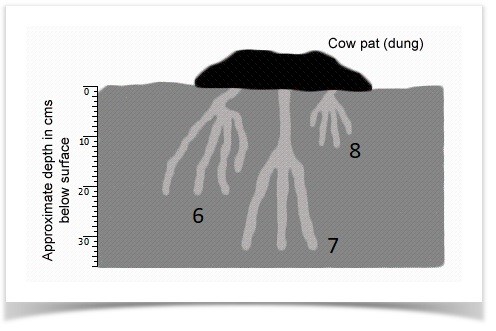
6. Shows a tunnel of approximately 20 cm below the surface of the cow pat (dung).
7. Shows a tunnel that is approximately 30 cm below the surface of the cow pat or cow dung.
8. Shows a tunnel that is approximately 10 cm below the surface of the cow pat /dung.
Questions 9-13
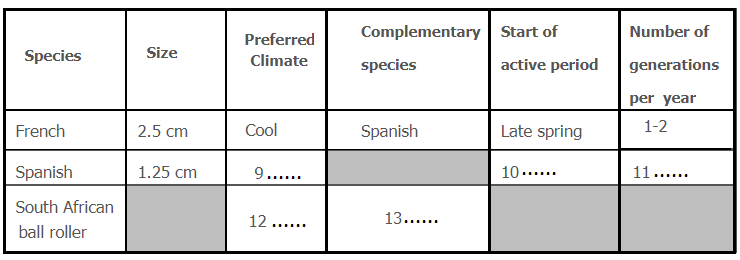
9. We need to find out the preferred climate of Spanish beetles.
10. We need to find out when is the start of the active period (time to reproduce) of Spanish beetles.
11. We need to find out how many generations the Spanish beetles produce annually or in a year.
12. We need to figure out the preferred climate of South African ball roller beetles.
13. Which is the last question in this reading passage, we need to figure out the name of the complementary species for South African ball roller beetles, i.e. which beetle species work with South African ball roller beetles.
Premium IELTS Coaching
at an Affordable Price
Answers of A Remarkable Beetle Reading Passage with Explanations
Read below to get answers of the above mentioned IELTS Reading passage along with the explanation.
Question 1
Question 2
Question 3

Unlock All Explanations for Free
Question 4
Question 5
Question 6
Question 7
Question 8
Question 9
Question 10
Question 11
Question 12
Question 13

IELTS Prep Boost
Unlimited Access Includes
Other Passages
Important Links for IELTS Exam
Explore Free IELTS Mock Tests
Find IELTS Coaching Centres
Practice Every IELTS Module
Essential IELTS Tools & Resources
Study Abroad Consultants in India
Top Study Abroad Destinations
Exams Required to Study Abroad
Popular Universities to Study Abroad
Important Links for IELTS Exam
Explore Free IELTS Mock Tests
Find IELTS Coaching Centres
Practice Every IELTS Module
Essential IELTS Tools & Resources
Study Abroad Consultants in India
Top Study Abroad Destinations
Popular Universities to Study Abroad
Quick Links
The passage “a remarkable beetle” reading answers contains details of the species of Beetles. Moreover, it revolves around the types of beetles and how they adapted to different climates.
Moreover, to boost your scores and improve your language skill enroll in online IELTS coaching. Gradding.com is a platform that aims to provide high-quality services. Our experts guide you to ease your studies along with your journey.
To get tips to boost your reading section read below.
Tips for Ace the Reading Passage on “A Remarkable Beetle”
The question types used in the IELTS Reading test, check the students skills and that's include:
Skimming: Reading to understand the main Idea
Scanning: Read the passage to find a specific piece of information
Reading for details: Reading to understand a logical argument, opinions, attitudes and writer’s purpose.
Following these tips will help you to score high in the reading section and to know the type of questions you come across in the given passage read blow to understand it.
Types of Questions in this Reading Passage
Scroll down to understand what type of questions you have come across in the above passage on the topic "a remarkable beetle” reading answers.
Yes, No, Not Given- Questions
Question types 1 to 5 were yes no and not given of task the candidate must assess whether statements are correct or not. You have to write “Yes” if it is correct and “No” if it's incorrect. Further, if the information is not mentioned in the passage then there is option “Not Given”.
Diagram Completion
In these type of question students have to label the diagram of either a process, an object, a structure or a machine. The aspirant should either fill the missing tags or complete the notes given in the diagram. The image completion assesses the ability to understand detailed descriptions and relations presented by the student in the form of a diagram.
Table Completion
The table completion questions in the IELTS reading test will be presented as an incomplete table of data, with either summaries or paragraph details given in the reading passage. The candidate needed to locate specific details in the passage, choose the appropriate words, and understand the meaning of the text. The words used in the blank space of the table shouldn’t exceed more than the number of words given in the guidelines.
These were the types that you encountered in the passage “a remarkable beetle” reading answers. However, if you feel the need to practice more, then you can sign up for either the IELTS mock test or online coaching. What you opt for in your exam preparation will lead to gaining the band score. If you want to boost your confidence by effective prep, then take practice tests. But, if you are feeling that you need to increase your skills or be fluent in your pronunciation, then enroll in the learning classes with us.
