
Collecting Ant Specimens Reading Answers with Explanations
In the IELTS exam, the reading section is one of the longest parts to achieve within a time duration. In this segment, candidates get three reading passages, which they have to attempt in 60 minutes. For each, test takers get 20 minutes for completion. If you want to challenge yourself then practice with the write-up collecting ant specimens reading answers. After taking this, you will have an idea of the task types and structure of the reading section.
Also, you can improve your prospects of getting high scores on the IELTS test. So, let’s explore the write-up.
IELTS Prep Boost
Elevate your preparation with exclusive tools
Unlimited Access Includes
BEST PLANDuration Days
IELTS Reading Passage - How to Spot a Liar Reading Answers
Paragraph- A
However much we may abhor it, deception comes naturally to all living things. Birds do it by feigning injury to lead hungry predators away from nesting young. Spider crabs do it by disguise: adorning themselves with strips of kelp and other debris, they pretend to be something they are not – and so escape their enemies. Nature amply rewards successful deceivers by allowing them to survive long enough to mate and reproduce. So it may come as no surprise to learn that human beings- who, according to psychologist Gerald Johnson of the University of South California, or lied to about 200 times a day, roughly one untruth every 5 minutes- often deceive for exactly the same reasons: to save their own skins or to get something they can’t get by other means.
Paragraph- B
But knowing how to catch deceit can be just as important a survival skill as knowing how to tell a lie and get away with it. A person able to spot falsehood quickly is unlikely to be swindled by an unscrupulous business associate or hoodwinked by a devious spouse. Luckily, nature provides more than enough clues to trap dissemblers in their own tangled webs- if you know where to look. By closely observing facial expressions, body language, and tone of voice, practically anyone can recognize the tell-tale signs of lying. Researchers are even programming computers – like those used on Lie Detector -to get at the truth by analyzing the same physical cues available to the naked eye and ear. “With the proper training, many people can learn to reliably detect lies,” says Paul Ekman, professor of psychology at the University of California, San Francisco, who has spent the past 15 years studying the secret art of deception.
Paragraph- C
In order to know what kind of Lies work best, successful liars need to accurately assess other people’s emotional states. Ackman’s research shows that this same emotional intelligence is essential for good lie detectors, too. The emotional state to watch out for is stress, the conflict most liars feel between the truth and what they actually say and do.
Paragraph- D
Even high-tech lie detectors don’t detect lies as such; they merely detect the physical cues of emotions, which may or may not correspond to what the person being tested is saying. Polygraphs, for instance, measure respiration, heart rate, and skin conductivity, which tend to increase when people are nervous – as they usually are when lying. Nervous people typically perspire, and the salts contained in perspiration conducts electricity. That’s why sudden leap in skin conductivity indicates nervousness -about getting caught, perhaps -which makes, in turn, suggest that someone is being economical with the truth. On the other hand, it might also mean that the lights in the television. The studio is too hot- which is one reason polygraph tests are inadmissible in court. “Good lie detectors don’t rely on a single thing,” says Ekma, but interpret clusters of verbal and non-verbal clues that suggest someone might be lying.”
Paragraph- E
The clues are written all over the face. Because the musculature of the face is directly connected to the areas of the brain that process emotion, the countenance can be a window to the soul. Neurological studies even suggest that genuine emotions travel different pathways through the brain than insincere ones. If a patient paralyzed by stroke on one side of the face, for example, is asked to smile deliberately, only the mobile side of the mouth is raised. But tell that same person a funny joke, and the patient breaks into a full and spontaneous smile. Very few people -most notably, actors and politicians- are able to consciously control all of their facial expressions. Lies can often be caught when the liars true feelings briefly leak through the mask of deception. We don’t think before we feel, Ekman says. “Expressions tend to show up on the face before we’re even conscious of experiencing an emotion.”
Paragraph- F
One of the most difficult facial expressions to fake- or conceal, if it’s genuinely felt - is sadness. When someone is truly sad, the forehead wrinkles with grief, and the inner corners of the eyebrows are pulled up. Fewer than 15% of the people Ekman tested were able to produce this eyebrow movement voluntarily. By contrast, the lowering of the eyebrows associated with an angry scowl can be replicated at will but almost everybody. “ If someone claims they are sad and the inner corners of their eyebrows don’t go up, Ekmam says, the sadness is probably false.”
Paragraph- G
The smile, on the other hand, is one of the easiest facial expressions to counterfeit. It takes just two muscles -the zygomaticus major muscles that extend from the cheekbones to the corners of the lips- to produce a grin. But there’s a catch. A genuine smile affects not only the corners of the lips but also the orbicularis oculi, the muscle around the eye that produces the distinctive “crow’s feet” associated with people who laugh a lot. A counterfeit grin can be unmasked if the corners of the lips go up, the eyes crinkle, but the inner corners of the eyebrows are not lowered, a movement controlled by the orbicularis oculi that is difficult to fake. The absence of lowered eyebrows is one reason why the smile looks so strained and stiff.
Questions for Reading Passage: How to Spot a Liar Reading Answers
Questions 1-5
1. All living animals can lie.
2. Some people tell lies for self-preservation.
3. Scientists have used computers to analyze which part of the brain is responsible for telling lies.
4. Lying as a survival skill is more important than detecting a lie.
5. To be a good liar, one has to understand other people's emotions.
Questions 6-9
6. How does the lie detector work?
a) It detects whether one's emotional state is stable.
b) It detects one’s brain activity level.
c) It detects body behavior during one's verbal response.
d) It analyses one's verbal response word by word.
7. Lie detectors can't be used as evidence in a court of law because
a) Lights often cause lie detectors to malfunction.
b) They are based on too many verbal and non-verbal clues.
c) Polygraph tests are often inaccurate.
d) There may be many causes of certain body behavior.
8. Why does the author mention the paralyzed patients?
a) To demonstrate how a paralyzed patient smiles
b) To show the relation between true emotions and body behavior
c) To examine how they were paralyzed
d) To show the importance of happiness from recovery
9. The author uses politicians to exemplify that they can
a) Have emotions.
b) Imitate actors.
c) Detect other people's lives.
d) Mask their true feelings.
Questions 10-13
10. Inner corners of eyebrows raised
11. The whole eyebrows lowered
12. Lines formed around
13. Lines form above eyebrows
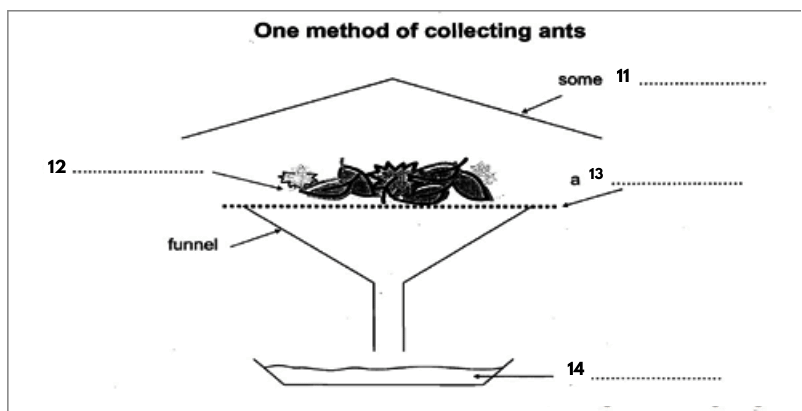
Questions 11-14
Premium IELTS Coaching
at an Affordable Price
Answers for Collecting Ant Specimens Reading Passage with Explanation
When you get an idea of solving questions in the reading passages, you can easily crack this section with high scores. So, let’s explore collecting ant specimens reading answers with detailed explanations.
Question 1
Question 2
Question 3

Unlock All Explanations for Free
Question 4
Question 5
Question 6
Question 7
Question 8
Question 9
Question 10
Question 11
Question 12
Question 13
Question 14

IELTS Prep Boost
Unlimited Access Includes
Other Passages
Important Links for IELTS Exam
Explore Free IELTS Mock Tests
Find IELTS Coaching Centres
Practice Every IELTS Module
Essential IELTS Tools & Resources
Study Abroad Consultants in India
Top Study Abroad Destinations
Exams Required to Study Abroad
Popular Universities to Study Abroad
Important Links for IELTS Exam
Explore Free IELTS Mock Tests
Find IELTS Coaching Centres
Practice Every IELTS Module
Essential IELTS Tools & Resources
Study Abroad Consultants in India
Top Study Abroad Destinations
Popular Universities to Study Abroad
Quick Links
The passage is about collecting ants specimens reading answers. The crux of the write-up is that gathering ants can be as simple as picking up stray and placing them in a jar or container. Also, it is difficult to complete an exhaustive survey of all species present in an area and estimate their relative affluence. However, the exact method used for collecting ants will depend on the final purpose of the collections. For taxonomy or long series, a single nest has all castes allowing the determination of variation within species. Sometimes, taxonomists overlook the whole individual under study, while the ecologist collects a limited number of specimens of species.
From this write-up, you have understood how your questions in the IELTS reading section will appear. After reading the complete passage, you can practice for your exam as a sample task. Moreover, you can take an IELTS reading mock test, particularly for this segment. With this, you can start regular practice by creating your day-wise study plan. This is one of the best ways to increase your confidence to attempt the test.
Tips for Acing the Collecting Ant Specimens Reading Answers
Completing the IELTS reading section within the time duration is challenging for test takers. Sometimes, it happens due to a lack of knowing proper strategies. Hence, to avoid mistakes here are some helpful tips for collecting ant specimens reading answers write-up.
- To get the correct answer from the passage, try to find synonyms. This technique will help you choose the accurate solution for the question.
- Never forget to read the whole passage to understand the main idea of the text.
- Use skimming to read quickly and scanning to identify the specific information. This will help you to find accurate answers faster and correctly.
Types of Questions in This Reading Passage
In the write-up of collecting ant specimens reading answers, there are three types of questions. Read ahead, and learn about it.
True/ False/ Not Given
In this type of question, students are asked to identify specific information from the passage. They need to write true, false, and not given based on the statements.
- Write “True” if the statement is correct.
- Answer “False” if the given sentence is wrong.
- Test takers write “Not Given” when the information of the statement is not provided in whole reading passage.
Classifying Statements
These are the questions in which test takers have to classify information from the reading passage. In this, candidates will have some statements or a list of options. These will be shown as a list e.g. A, B, C, etc. After this, learners must match these phrases with the correct option from the text.
Labeling Diagram
Labeling diagrams questions will be given in a paragraph or a diagram. In this, you have to label the parts referring to the text. To answers the tasks, your word limit must be up to one or two words. In this, you must find the correct keywords in the passage and most likely the accurate answers.
Conclusion
With the help of the write-up of collecting ant specimens reading answers, you have a close overview of the task that can come in the IELTS reading section. Also, you know how to attempt these questions to find the correct answers. You can achieve a good result with high scores if you have practice with sample reading passages. For that, you can connect with Gradding.com, where you will get offline or online IELTS coaching as you feel suitable. Here, test takers will get the benefits of studying from highly skilled tutors. Also, they will provide good quality study material to prepare for the exam with good strategies.
