
Dino Discoveries Reading Answers with Explanations
The IELTS reading test is the way to demonstrate your proficiency in English. Thus, practicing for the exam will put you one step ahead in scoring well. But, if you have not solved any sample tests yet, this is the chance to begin your journey.
The following write-up answers the dino discoveries reading passage, along with the explanations, which will help you score well in the exam. So let us begin and see how well you can adapt the text within time constraints.
IELTS Prep Boost
Elevate your preparation with exclusive tools
Unlimited Access Includes
BEST PLANDuration Days
IELTS Reading Passage - Dino Discoveries
Paragraph 1
When news breaks of the discovery of a new species of dinosaur, you would be forgiven for thinking that the scientists who set out in search of the fossils are the ones who made die find. The reality tells a different story, as Cavan Scott explains.
Paragraph 2
The BBC series Planet Dinosaur used state-of-the-art computer graphics to bring to life the most impressive of those dinosaurs whose remains have been discovered in the past decade. One of these is Gigantoraptor erlianensis. Discovered in 2005. It stands more than three metres high at the hip and is the biggest bird-like dinosaur ever unearthed Yet its discoverer. Xu Xing of Beijing's Institute of Vertebrate Palaeontology and Paleoanthropology was not even looking for it at the time. He was recording a documentary in the Gobi Desert, Inner Mongolia.
Paragraph 3
'The production team were filming me and a geologist digging out what we thought were sauropod bones,' says Xu. 'When I realised the fossils were something else entirely.' Gigantoraptor, as it later became known, turned out to be an oviraptorid, a therapod with a bird-like beak. Its size was staggering. The largest oviraptorid previously discovered had been comparable in size to an emu: the majority were about as big as a turkey. Here was a creature that was probably about eight metres long, if the bone analysis was anything to go by.
Paragraph 4
Sometimes it is sheer opportunism that plays a part in the discovery of a new species. In 1999. The National Geographic Society announced that the missing link between dinosaurs and modern birds had finally been found. Named Archaeoraptor lianoingensis. The fossil in question appeared to have the head and body of a bird, with the hind legs and tail of a 124-million-year-old dromaeosaur - a family of small theropods that include the bird-like Velociraptor made famous by Jurassic Park films.
Paragraph 5
There was a good reason why the fossil looked half-bird, half-dinosaur. CT scans almost immediately proved the specimen was bogus and had been created by an industrious Chinese farmer who had glued two separate fossils together to create a profitable hoax.
Paragraph 6
But while the palaeontologists behind the announcement were wiping egg off their faces, others, including Xu, were taking note. The head and body of the fake composite belonged to Yanornis martini, a primitive fish-eating bird from around 120 million years ago. The dromaeosaur tail and hind legs, however, were covered in what looked like fine proto feathers. That fossil turned out to be something special. In 2000. Xu named it Microraptor and revealed that it had probably lived in the treetops. Although it couldn't fly, its curved claws provided the first real evidence that dinosaurs could have climbed trees. Three years later. Xu and his team discovered a closely related Microraptor species, which changed everything. 'Microraptor had two salient features.' Xu explains, long feathers were attached not just to its forearms but to its legs and claws. Then we noticed that these long feathers had asymmetrical vanes, a feature often associated with flight capability. This meant that we might have found a flying dinosaur.'
Paragraph 7
Some extraordinary fossils have remained hidden in a collection and are almost forgotten. For the majority of the 20th century, the palaeontology community had ignored the frozen tundra of northern Alaska. There was no way. Scientists believed that cold-blooded dinosaurs could survive in such bleak, frigid conditions. But according to Alaskan dinosaur expert Tony Fiorillo. They eventually realised they were missing a trick.
Paragraph 8
The first discovery of dinosaurs in Alaska was actually made by a geologist called Robert Liscomb in 1961.' says Fiorillo. 'Unfortunately, Robert was killed in a rockslide the following year, so his discoveries languished in a warehouse for the next two decades.' In the mid-1980s, managers at the warehouse stumbled upon the box containing Liscomb's fossils during a spring clean. The bones were sent to the United States Geological Survey, where they were identified as belonging to Edmontosaurus. a duck-billed hadrosaur. Today, palaeontologists roam this frozen treasure trove searching for remains locked away in the permafrost.
Paragraph 9
The rewards are worth the effort. While studying teeth belonging to the relatively intelligent Troodon therapod. Fiorillo discovered the teeth of the Alaskan Troodon were double the size of those of its southern counterpart. 'Even though the morphology of individual teeth resembled that of Troodon. The size was significantly larger than the Troodon found in warmer climates. Fiorillo says that the reason lies in the Troodon's large eyes, which allowed it to hunt at dawn and at dusk - times when other dinosaurs would have struggled to see. In the polar conditions of Cretaceous Alaska, where the Sun would all but disappear for months on end, this proved a useful talent. Troodon adapted for life in the extraordinary light regimes of the polar world. With this advantage, it took over as Alaska's dominant therapod.' explains Fiorillo.
Paragraph 10
Finding itself at the top of the food chain, the dinosaur evolved to giant proportions. It is true that some of the most staggering of recent developments have come from palaeontologists being in the right place at the right time, but this is no reflection on their knowledge or expertise. After all, not everyone knows when they've stumbled upon something remarkable. When Argentine sheep farmer Guillermo Heredia uncovered what he believed was a petrified tree Irunk on his Patagonian farm in 1988. he had no way of realising that he'd found a 1.5-metre-long tibia of the largest sauropod ever known to walk the Earth. Argenlinosaurus was 24 metres long and weighed 75 tonnes. The titanosaur was brought to the attention of the scientific community in 1993 by Rodolfo Coria and Jose Bonaparte of the National Museum of Natural Sciences in Buenos Aires. Coria points out that most breakthroughs are not made by scientists, but by ordinary folk. 'But the real scientific discovery is not the finding; it's what we learn from that finding.' While any one of us can unearth a fossil, it takes dedicated scientists to see beyond the rock.
Questions for Reading Passage- Dino Discoveries
Questions 1-6
Do the following statements agree with the information in the Reading Passage?
Write
TRUE- if the statement agrees with the information
FALSE- if the statement contradicts the information
NOT GIVEN- if there is no information on this
1. Xu Xing went to the Gobi Desert to check fossil evidence of the existence of Gigantoraptor erlianensis.
2. The announcement made by the National Geographic Society in 1999 was based on false evidence.
3. Like Gigantoraptor, Yanomis martini was first discovered in China.
4. The bones originally discovered by Robert Liscomb changed the attitude of palaeontologists towards north Alaska.
5. According to Fiorillo. The name Troodon means ‘wounding tooth’.
6. Guillermo Heredia had suspected that his find was a dinosaur fossil.
Questions 7-13
Choose NO MORE THAN TWO WORDS AND/OR A NUMBER from the passage for each answer.
Complete the labels on the diagrams below.
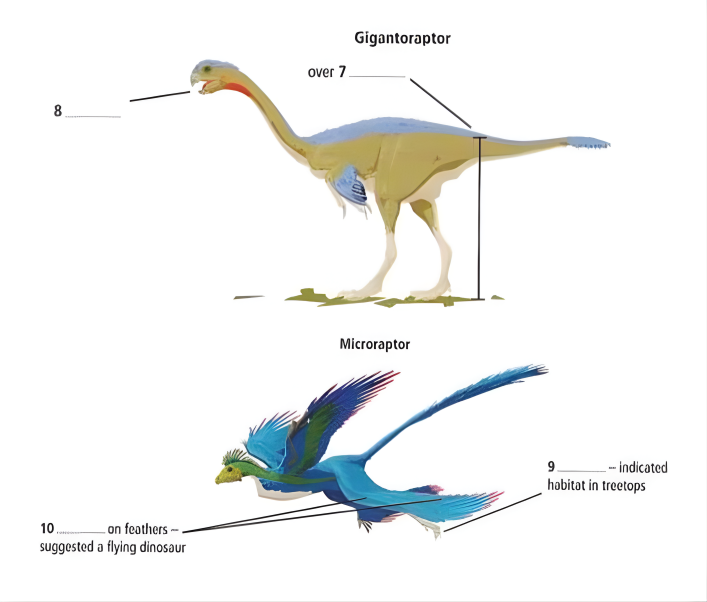
7. ___________
8. ___________
9. ___________
10. ___________
11. ___________
12. ___________
13. ___________
Premium IELTS Coaching
at an Affordable Price
Answers for Dino Discoveries Reading Passage
This section contains the answers of A Dino discoveries along with their explanations. You have to carefully read the questions and write correct responses on your own. Thus, read below for a better understanding.
Question 1
Question 2
Question 3

Unlock All Explanations for Free
Question 4
Question 5
Question 6
Question 7
Question 8
Question 9
Question 10
Question 11
Question 12
Question 13

IELTS Prep Boost
Unlimited Access Includes
Other Passages
Important Links for IELTS Exam
Explore Free IELTS Mock Tests
Find IELTS Coaching Centres
Practice Every IELTS Module
Essential IELTS Tools & Resources
Study Abroad Consultants in India
Top Study Abroad Destinations
Exams Required to Study Abroad
Popular Universities to Study Abroad
Important Links for IELTS Exam
Explore Free IELTS Mock Tests
Find IELTS Coaching Centres
Practice Every IELTS Module
Essential IELTS Tools & Resources
Study Abroad Consultants in India
Top Study Abroad Destinations
Popular Universities to Study Abroad
Quick Links
The above A Dino discoveries reading answers are a sample for you. It discusses many recent dinosaur fossil findings and how they have challenged long-standing scientific specific beliefs.
This passage includes a total of 13 questions, and all are based on true, false, not given, or diagram label completion type. So skim through the text and answer the question. Besides, if you find this sample relevant and want to practice more of it, you can take the help of an IELTS reading mock test and practice in a real exam environment. It helps the test taker to get familiar with the exam format, question types, and time limit.
Tips for Acing the Dino Discoveries Reading Passage
To ace the IELTS reading test, you need to prepare for the strategies that will help you score well in the exam. Therefore, here are some of the tips that will help you improve your reading skills.
- You will have 1 hour to answer 40 questions, so you must use your time wisely.
- Pay close attention to the instructions given to avoid losing marks.
- Take practice tests to build your speed and accuracy.
- Instead of searching for the right answer first, try to solve the incorrect one.
Types of Questions in the Dino Discoveries Reading Passage
This reading passage has a total of 13 questions of two types. Test takers can score well if they approach every single task with a unique method. Thus, read further to understand the different question types this passage contains.
True, False, Not Given
This type of question assesses your ability to understand the factual information in the passage. You will be given a series of statements, and you will have to decide whether they are-
True - the statement agrees with the information in the passage.
False - the statement contradicts the information in the passage.
Not given - the information that is not mentioned in the passage.
Diagram Label Completion
In the diagram label question, you will be given a diagram with a process, plan, or technical drawing and must locate the correct terms in the passage to fill in the blanks, often with a strict word limit. Read through the passage and look for keywords that match the diagram's subject.
Additionally, if you want to enhance your skills in various question types with answers, take the help of online IELTS coaching from gradding.com to improve the weaker sections. This coaching will help you in skimming and scanning the passage to locate information and answer the questions.
Conclusion
Winding up! You have just explored the dino discoveries IELTS reading answers along with the explanations. Every task here requires a strategic approach, and now you have all the skills to handle them. But you should not stop here by solving just one reading passage. Moreover, if you are looking for more study materials, referring to the IELTS sample test PDF can be a great choice because you can download it and start practicing whenever you want.
