
Domestic Robots Reading Answers with Explanations
Achieving a good band score in the IELTS reading section can be challenging for many students. Sometimes they find the text information difficult to understand or the question pattern. In that case, only practice is the way you can use to prepare for the test. If you are not sure which study material is best for you, this guide can help you. Here, we will provide you with a sample test containing domestic robots reading answers along with explanations.
Once you are done with practicing, you will be able to understand the test format and easily find solutions. Practice on!
IELTS Prep Boost
Elevate your preparation with exclusive tools
Unlimited Access Includes
BEST PLANDuration Days
IELTS Reading Passage: Domestic Robots
Machines that look after your home are getting cleverer, but they still need care and attention if they are to perform as intended.
Floor-cleaning machines capable of responding to their environment were among the first commercially available domestic products worthy of being called robots. The best known is the Roomba, made by iRobot, an American company that has sold more than three million of the discshaped, frisbee-sized vacuuming robots. The latest model, the fifth version of the Roomba, has more sensors and cleverer software than its predecessors. Press the 'Clean' button, and the robot glides out of its docking station and sets off across the floor.
Domestic robots are supposed to free up time so that you can do other things, but watching how the Roomba deals with obstacles is strangely compelling. It is capable of sensing its surroundings, and does not simply try to adhere to a pre-planned route, so it is not upset if furniture is moved, or if it is picked up and taken to clean another room. Its infra-red sensors enable it to slow down before reaching an obstacle - such as a dozy cat - changing direction and setting off again.
It steadily works its way around the room, figuring out how to get out from under the television stand or untangle itself from a stray Game Boy recharging lead. Watch it for long enough, and you can sometimes predict its next move. The machine has a 'dirt sensor' and flashes a blue light when it finds things to clean up. Only when it detects no more dirt does it stop going over the same area and, eventually, conclude that the whole room is clean. It then trundles back to the dock at its recharging station.
So the first observation of life with a domestic robot is that you will keep watching it before you trust it completely. Perhaps that is not surprising: after all, when automatic washing machines first appeared, people used to draw up a chair and sit and watch them complete their wash, rinse, and spin cycles. Now they just load them, switch them on, and leave them to it.
The second observation is that, despite their current level of intelligence, certain allowances must be made to get the best out of a domestic robot. The Roomba can be set up to clean at particular times, and to clean more than one room (small infra-red 'lighthouses' can be positioned in doorways, creating an invisible barrier between one room and the next that is only removed when the first room has been cleaned). A 'drop-off' sensor underneath the robot prevents it from falling down stairs. All very clever, but what the Roomba will not do is pick up toys, shoes, and other items left lying around. Rooms cared for by robots must be kept tidy. To start with, children will happily put things away in order to watch the robot set off, but unfortunately, the novelty soon wears off.
Similar allowances must be made for other domestic robots. Sweden's Husqvarna recently launched a new version of its Automower lawn mowing robot. Before it can be used, a wire must be placed around the perimeter of the lawn to define the part to be cut. If toys and other obstacles are not cleared from the lawn before it starts work, the robot will steer around them, leaving uncut areas. However, the latest version can top up its batteries with solar power, or send its owner a text message if it gets into trouble trying to climb a mole-hill.
But there is still only a limited range of domestic robots. Machines that mop the floor, clean a swimming pool and clear muck from guttering are made by iRobot. Several surveillance robots are also on offer. The Rovio, made by WowWee of Hong Kong, is a Wi-Fi-enabled webcam, mounted on an extending arm, which rides along smoothly on a nimble set of three wheels. Its movement can be remotely operated over the Internet via a laptop or mobile phone. The idea is that Rovio can patrol the home when its owner is away, either automatically or under manual control: in the latter case, two-way communication allows the operator to see and talk via the machine. So you could, for instance, shout at the cat if it is sleeping on your best sofa.
Some machines are called robots even though they cannot move around. There is an ironing robot, for instance, that resembles an inflatable dummy: put a damp shirt on it, and it puffs up to remove the creases. Similarly, there are elaborate trouser presses that aspire to be robots. But do these devices really count as robots? If so, then surely dishwashers and washing machines do, too.
Yet whatever shape or size robots come in, many will be adored. Another important observation from living with a robot is that it tends to become part of the family. 'People give them names, and if they have to be sent back for repair, they carefully add a mark to them to ensure they get the same machine back,' says Nancy Dussault Smith of iRobot.
Questions for Reading Passage: Domestic Robots
Questions 1-6
Do the following statements agree with the information given in the reading passage?
Write
TRUE, if the statement agrees with the information
FALSE, if the statement contradicts the information
NOT GIVEN, if there is no information on this
1. Improvements have been made to Roomba over time.
2. Obstacles have to be removed from Roomba’s path.
3. Roomba keeps cleaning in one place until it thinks it is dirt-free.
4. People once found washing machines as fascinating as robots.
5. Comparative studies are available on the intelligence of domestic robots.
6. Roomba tidies up a room as well as cleaning it.
Questions 7-10
Answer the questions below.
Use NO MORE THAN THREE WORDS from the passage for each answer.
7. What is used to mark out the mowing area for the Automower?
8. What form of renewable energy can some Automowers use?
9. What does the ironing robot look like?
10. What do people often put on a robot when it is going to be repaired?
Questions 11-13
Label the diagram below.
Choose NO MORE THAN THREE WORDS from the passage for each answer.
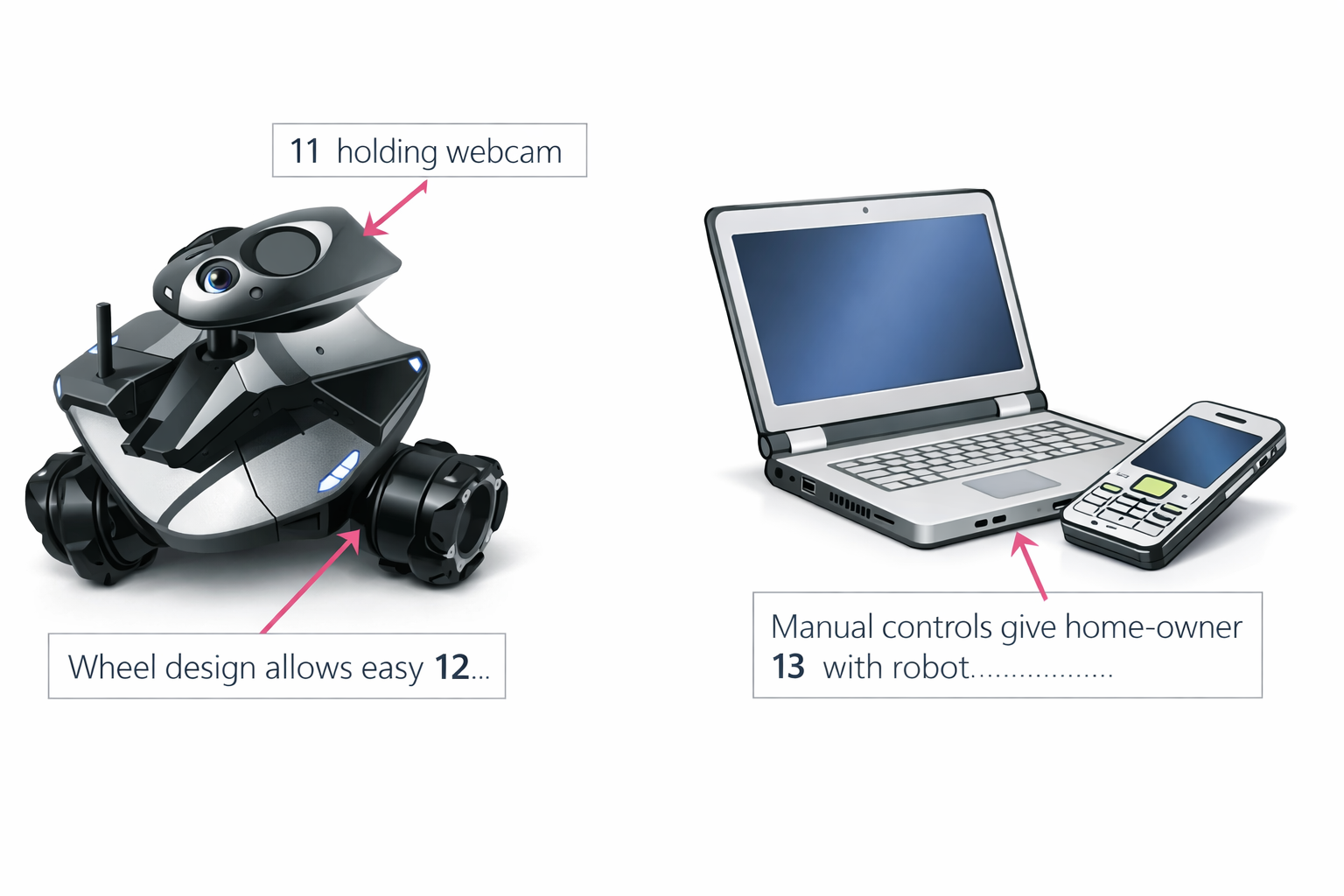
11. ___ holding webcam.
12. Wheel design allows easy ___
13. Manual controls give home-owner ___ with robot.
Premium IELTS Coaching
at an Affordable Price
Answers for Domestic Robots Reading Passage with Explanations
Finding the domestic robots reading answers will be simple for you if you focus on the text and read the instructions well. In the following information, we have provided you with the answers along with their explanation. At first, solve all of the questions on your own, then match your responses with the list below.
Question 1
Question 2
Question 3

Unlock All Explanations for Free
Question 4
Question 5
Question 6
Question 7
Question 8
Question 9
Question 10
Question 11
Question 12
Question 13

IELTS Prep Boost
Unlimited Access Includes
Other Passages
Important Links for IELTS Exam
Explore Free IELTS Mock Tests
Find IELTS Coaching Centres
Practice Every IELTS Module
Essential IELTS Tools & Resources
Study Abroad Consultants in India
Top Study Abroad Destinations
Exams Required to Study Abroad
Popular Universities to Study Abroad
Important Links for IELTS Exam
Explore Free IELTS Mock Tests
Find IELTS Coaching Centres
Practice Every IELTS Module
Essential IELTS Tools & Resources
Study Abroad Consultants in India
Top Study Abroad Destinations
Popular Universities to Study Abroad
Quick Links
With the above information, you have explored the answers of domestic robots reading passage. Here, the text discusses how these autonomous home helpers, like the Roomba vacuum, use sensors to navigate, clean, and avoid obstacles, freeing human time but requiring users to prepare the environment, and how people often develop attachments, giving them names and treating them as family, highlighting both practical benefits and human-robot interaction. Machines that look after your home are getting cleverer, but they still need care and attention if they are to perform as intended.
This was the quick overview of the passage. Hopefully, you have understood it and practiced well. You can also use an IELTS reading mock test if you want to practice in the real exam environment.
Tips for Acing Domestic Robots Reading Answers
If you know the right strategy to solve questions, you can easily find responses in the reading section. In the domestic robots reading answers, there are thirteen questions covered. You can follow the strategies that we have provided and find the correct answers while practicing.
- While solving true, false, and not given questions, first read the statement and underline keywords, then scan the passage for synonyms or paraphrased keywords to find the relevant section, and carefully compare the statement’s meaning to the text.
- In short-answer type questions, read instructions carefully for word limits, underline keywords in questions, and scan the text in order to find those keywords or synonyms, focusing on the specific information requested to find exact words from the passage, being careful with spelling and grammar.
- To solve diagram labeling questions, first read the instructions and examine the diagram for clues or headings, then scan the text for keywords related to the diagram parts, read the relevant section closely to match descriptions with labels, and finally write answers, checking spelling and word count, remembering answers might not be in order.
Note: If you want to practice on your own for more types of samples, you can explore our website or download free IELTS sample test PDFs to rehearse anytime you want.
Types of Questions in the Domestic Robots Reading Passage
There are three types of questions covered in the answers of domestic robots passage. Here, each contains different criteria for answering and word limits. To know in detail, follow the information below.
True, False, Not Given Questions (1-6)
The true, false, and not given question type asks you to judge if statements match a text. This task tests specific details, requiring careful reading to distinguish between a direct contradiction and missing information. After analyzing, you will write:
- True, if the statement agrees with the information.
- False, if the statement contradicts the information.
- Not given, if there is no information on this.
Short Answer Type Questions (7-10)
You have given 7 to 10 questions based on short-answer type questions. In this, you have given open-ended questions that you have to answer within no more than three words. At first, read the question and identify what it is asking. Then, locate the answers in sequence and not your own ideas.
Diagram Labelling Questions (11-13)
There are 11 to 13 questions based on diagram labelling. This task requires you to fill in missing labels on a diagram, map, plan, or technical drawing using words taken directly from the provided reading passage, focusing on understanding spatial information and matching terms to visual parts of a process or object described in the text.
Conclusion
In a wrap-up, we have discussed the domestic robots reading answers in detail on this page. If you have solved all the answers correctly, hopefully, now you are ready to explore more like this. There are more ways you can use to practice for the reading and other sections as well. You can join either offline or online IELTS coaching and grab a chance to learn under a professional’s guidance.
