
Keep a Watchful Eye on the Bridges Reading Answers with Explanation
Are you preparing for the IELTS exam and looking for the reading passage to enhance your preparation? If so, try solving the answers of keep a watchful eye on the bridges reading passage for reference. In addition, you can find detailed explanations for the responses along with the location below moreover, practice by noting down the difficult vocabulary from the passage and analyzing its connections.
The IELTS reading section checks test takers' English language skills with four different types of questions. However, you must finish all of them within 20 minutes. Aim to answer the passage within the given duration.
IELTS Prep Boost
Elevate your preparation with exclusive tools
Unlimited Access Includes
BEST PLANDuration Days
IELTS Reading Passage: Keep a Watchful Eye on the Bridges
Paragraph 1
Most road and rail bridges are only inspected visually, if at all. Every few months, engineers have to clamber over the structure in an attempt to find problems before the bridge shows obvious signs of damage. Technologies developed at Los Alamos National Laboratory, New Mexico, and Texas A&M University may replace these surveys with microwave sensors that constantly monitor the condition of bridges.
Paragraph 2
“The device uses microwaves to measure the distance between the sensor and the bridge, much like radar does,” says Albert Migliori, a Los Alamos physicist “Any load on the bridge – such as traffic induces displacements, which change that distance as the bridge moves up and down.” By monitoring these movements over several minutes, the researchers can find out how the bridge resonates. Changes in its behavior can give an early warning of damage.
Paragraph 3
The Interstate 40 bridge over the Rio Grande River in Albuquerque provided the researchers with a rare opportunity to test their ideas. Chuck Farrar, an engineer at Los Alamos, explains: “The New Mexico authorities decided to raze this bridge and replace it. We were able to mount instruments on it, test it under various load conditions, and even inflict damage just before it was demolished.” In the 1960s and 1970s, 2500 similar bridges were built in the US. They have two steel girders supporting the load in each section. Highway experts know that this design is “fracture critical” because a failure in either girder would cause the bridge to fail.
Paragraph 4
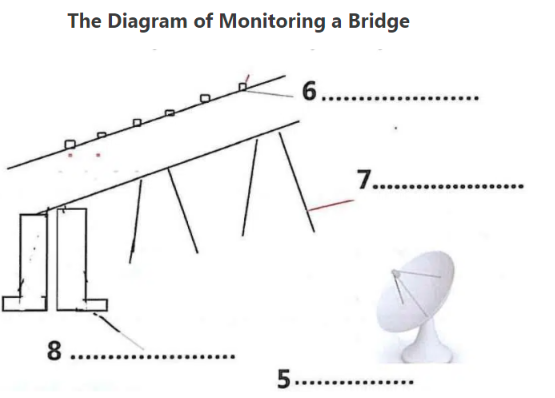
After setting up the microwave dish on the ground below the bridge, the Los Alamos team installed conventional accelerometers at several points along the span to measure its motion. They then tested the bridge while traffic roared across it and while subjecting it to pounding from a “shaker”, which delivered precise punches to a specific point on the road.
Paragraph 5
“We then created damage that we hoped would simulate fatigue cracks that can occur in steel girders,” says Farrar. They first cut a slot about 60 centimeters long in the middle of one girder. They then extended the cut until it reached the bottom of the girder and finally, they cut across the flange – the bottom of the girder’s “I” shape.
Paragraph 6
The initial, crude analysis of the bridge’s behavior, based on the frequency at which the bridge resonates, did not indicate that anything was wrong until the flange was damaged. But later the data were reanalyzed with algorithms that took into account changes in the mode shapes of the structure – shapes that the structure takes on when excited at a particular frequency. These more sophisticated algorithms, which were developed by Norris Stubbs at Texas A&M University, successfully identified and located the damage caused by the initial cut.
Paragraph 7
“When any structure vibrates, the energy is distributed throughout with some points not moving, while others vibrate strongly at various frequencies,” says Stubbs. “My algorithms use pattern recognition to detect changes in the distribution of this energy.” NASA already uses Stubbs’ method to check the behavior of the body flap that slows space shuttles down after they land.
Paragraph 8
A commercial system based on the Los Alamos hardware is now available, complete with the Stubbs algorithms, from the Quatro Corporation in Albuquerque for about $100,000. Tim Darling, another Los Alamos physicist working on the microwave interferometer with Migliori, says that as the electronics become cheaper, a microwave inspection system will eventually be applied to most large bridges in the US. “In a decade I would like to see a battery or solar-powered package mounted under each bridge, scanning it every day to detect changes,” he says.
Questions for Reading Passage: Keep a Watchful Eye on the Bridges
Questions 1-4
Choose the correct letter, A, B, C, or D.
Write your answers in boxes 1-4 on your answer sheet.
1. How did the traditional way to prevent damage of the bridges before the invention of new monitoring system
A. Bridges has to be tested in every movement on two points.
B. Bridges has to be closely monitored by microwave devices.
C. Bridges has already been monitored by sensors.
D. Bridges has to be frequently inspected by professional workers with naked eyes.
2. How does the new microwave monitors find out the problems of bridges
A. by changeling the distance between the positions of devices
B. by controlling the traffic flow on the bridges
C. by monitoring the distance caused by traffic between two points
D. by displacement of the several critical parts in the bridges
3. Why did the expert believe there is a problem for the design called “fracture critical”
A. Engineers failed to apply the newly developed construction materials.
B. There was not enough finance to repair the bridges.
C. The supporting parts of the bridges may crack and cause the bridge to fail.
D. There were bigger traffic load conditions than the designers had anticipated.
4. Defect was not recognized by a basic method in the beginning
A. until the mid of faces of bridges has fractures.
B. until the damage appears along and down to the flanges.
C. until the points on the road have been punched.
D. until the frequency of resonates appears disordered.
Questions 5-8
Filling the blanks in the diagram labels.
Write the correct answer in boxes 5-8 on your answer sheet.
Questions 9-13
The reading Passage has eight paragraphs, A–H.
Which paragraph contains the following information?
Write the correct letter, A–H, in boxes 9–13 on your answer sheet.
9. how is the pressure that they have many a great chance to test bridges
10. a ten-year positive change for microwave device
11. the chance they get an honorable contract
12. explanation of the mechanism for the new microwave monitoring to work
13. how is the damage deliberately created by the researchers
Premium IELTS Coaching
at an Affordable Price
Answers for Keep a Watchful Eye on the Bridges Reading Passage with Explanation
Here are the answers of keep a watchful eye on the bridges with explanations and locations.
Question 1
Question 2
Question 3

Unlock All Explanations for Free
Question 4
Question 5
Question 6
Question 7
Question 8
Question 9
Question 10
Question 11
Question 12
Question 13

IELTS Prep Boost
Unlimited Access Includes
Other Passages
Important Links for IELTS Exam
Explore Free IELTS Mock Tests
Find IELTS Coaching Centres
Practice Every IELTS Module
Essential IELTS Tools & Resources
Study Abroad Consultants in India
Top Study Abroad Destinations
Exams Required to Study Abroad
Popular Universities to Study Abroad
Important Links for IELTS Exam
Explore Free IELTS Mock Tests
Find IELTS Coaching Centres
Practice Every IELTS Module
Essential IELTS Tools & Resources
Study Abroad Consultants in India
Top Study Abroad Destinations
Popular Universities to Study Abroad
Quick Links
The above “Keep a Watchful Eye on the Bridges” reading passage discusses advancements in bridge inspection technology. In addition, traditional visual inspection are being supplemented with microwave sensors developed by Los Alamos National Laboratory and Texas A&M University. Thus, these sensors, which work similarly to radar, monitor bridge conditions by detecting changes in distance due to traffic and other stresses. Tests on the Interstate 40 bridge demonstrate that these sensors, combined with sophisticated algorithms for analyzing vibrations, can detect damage earlier than traditional methods. A commercial system for this technology is now available and could become widespread as costs decrease.
Hence, for your reading section preparation, understanding such technological advancements can help with questions about specific details and implications in the passage. So, focus on solving the answers of keep a watchful eye on the bridges to improve your IELTS reading scores through comprehension of complex details and their real-world significance. You can also take our online IELTS coaching to enhance your skimming and scanning abilities.
Tips for Mastering The Reading Passage on “Keep a Watchful Eye on the Bridges”
Below are some tips to assist you in finding the keep a watchful eye on the bridges reading answers easily.
- Multiple Choice Question: You should use IELTS reading keyword techniques to gain a rough understanding of the main idea of the passage.
- Diagram Completion:Start by locating the passage’s relevant section.
- Matching Information: Make sure to check all relevant paragraphs, as the right information might be mentioned in more than one place.
Types of Questions in this Reading Passage
The keep a watchful eye on the bridges reading answers covering three question types. Let’s delve into a detailed discussion on them:
Multiple Choice Question
These types of questions in the IELTS reading section involve identifying the right choice from the given options using the given paragraphs.
Moreover, take a look below to know how to answer best:
- Understand the Context
- Identify Keywords
- Eliminate Wrong Choice
- Look for Synonyms
- Double-Check Your Answers
Diagram Completion
To answer this type of question in the IELTS reading section, carefully check the diagram provided and match the labeled components or section with the corresponding information found in the passage.
Moreover, take a look below to know how to answer best:
- Read Instructions Carefully
- Examine the Diagram
- Identify Keywords
- Use Context Clues
- Stay Within Word Limits
Matching Information
These types of questions contain reading the descriptions or statements provided, identifying key details or keywords, and matching them to corresponding details in the passage by comparing and contrasting the options until you find the best fit.
Moreover, take a look below to know how to answer best:
- Skim the Passage
- Identify Keywords
- Scan the Keywords
- Read in Details
- Check All Options
Summing up, we discussed the keep a watchful eye on the bridges reading answers with detailed explanations. However, this section needs more practice and techniques so a student must be aware of it. Moreover, for more such exposure to write-up, you can take our IELTS reading mock test at Gradding.com with the help of AI technology.
