
The Concept of Role Theory Reading Answers with Explanations
In your whole journey of the IELTS exam, one of the toughest parts is the IELTS reading section. However, the reason is that you will get the three passages to attempt, which you have to do in just 60 minutes. To accomplish this segment, you have to practice different types of write-ups.
For example, test takers can start with the concept of role theory reading answers. After analyzing its question types and solutions, you will have an idea to tackle them during the test. So, without wasting time, let us begin first with the passage.
IELTS Prep Boost
Elevate your preparation with exclusive tools
Unlimited Access Includes
BEST PLANDuration Days
IELTS Reading Passage: The Concept of Role Theory
Introduction
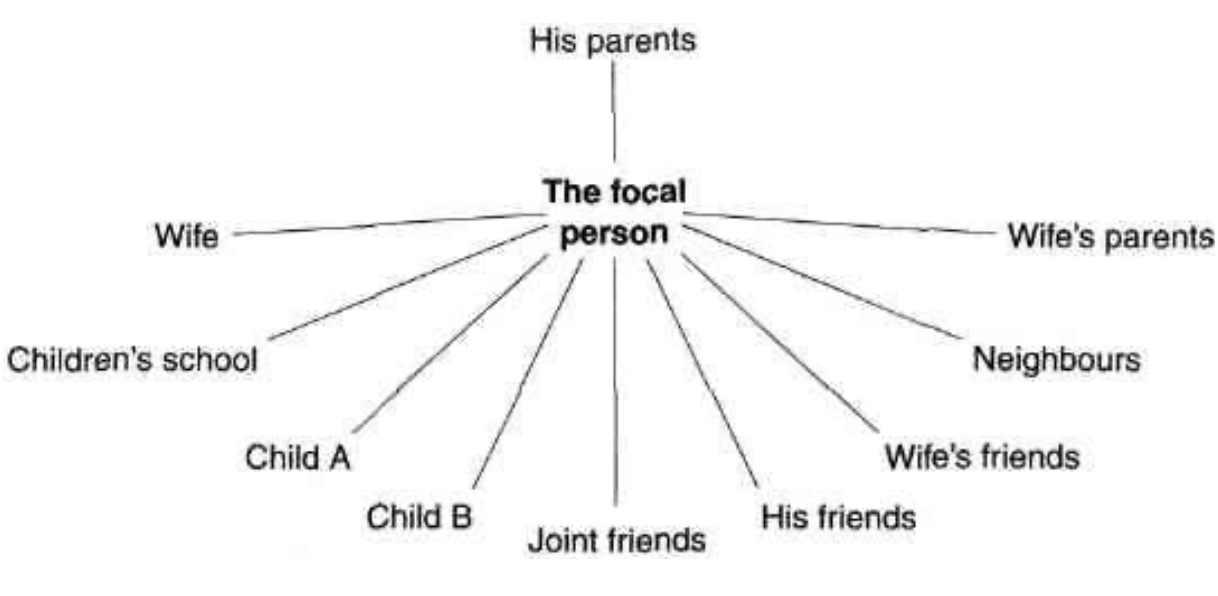
Any individual in any situation occupies a role in relation to other people. The particular individual with whom one is concerned in the analysis of any situation is usually given the name of focal person. He has the focal role and can be regarded as sitting in the middle of a group of people, with whom he interacts in some way in that situation. This group of people is called his role set. For instance, in the family situation, an individual’s role set might be shown as in Figure 6 Role set
Role definition (Paragraph- A)
The definition of any individual’s role in any situation will be a combination of the role expectations that the members of the role set have of the focal role. These expectations are often occupationally denned, sometimes even legally so. The role definitions of lawyers and doctors are fairly clearly defined both in legal and in cultural terms. The role definitions of, say, a film star or bank manager, are also fairly clearly defined in cultural terms, too clearly perhaps.
(Paragraph- B)
Individuals often find it hard to escape from the role that cultural traditions have defined for them. Not only with doctors or lawyers is the required role behaviour so constrained that if you are in that role for long it eventually becomes part of you, part of your personality. Hence, there is some likelihood that all accountants will be alike or that all blondes are similar - they are forced that way by the expectations of their role.
(Paragraph- C)
It is often important that you make it clear what your particular role is at a given time. The means of doing this are called, rather obviously, role signs. The simplest of role signs is a uniform. The number of stripes on your arm or pips on your shoulder is a very precise role definition which allows you to do certain very prescribed things in certain situations. Imagine yourself questioning a stranger on a dark street at midnight without wearing the role signs of a policeman!
(Paragraph- D)
In social circumstances, dress has often been used as a role sign to indicate the nature and degree of formality of any gathering and occasionally the social status of people present. The current trend towards blurring these role signs in dress is probably democratic, but it also makes some people very insecure. Without role signs, who is to know who has what role?
(Paragraph- E)
Place is another role sign. Managers often behave very differently outside the office and in it, even to the same person. They use a change of location to indicate a change in role from, say, boss to friend. Indeed, if you wish to change your roles you must find some outward sign that you are doing so or you won’t be permitted to change - the subordinate will continue to hear you as his boss no matter how hard you try to be his friend. In very significant cases of role change, e.g. from a soldier in the ranks to officer, from bachelor to married man, the change of role has to have a very obvious sign, hence rituals. It is interesting to observe, for instance, some decline in the emphasis given to marriage rituals. This could be taken as an indication that there is no longer such a big change in role from single to married person, and therefore no need for a public change in sign.
(Paragraph- F)
In organisations, office signs and furniture are often used as role signs. These and other perquisites of status are often frowned upon, but they may serve a purpose as a kind of uniform in a democratic society; roles without signs often lead to confused or differing expectations of the role of the focal person.
Role ambiguity (Paragraph- A)
Role ambiguity results when there is some uncertainty in the minds, either of the focal person or of the members of his role set, as to precisely what his role is at any given time. One of the crucial expectations that shape the role definition is that of the individual, the focal person himself. If his occupation of the role is unclear, or if it differs from that of the others in the role set, there will be a degree of role ambiguity. Is this bad? Not necessarily, for the ability to shape one’s own role is one of the freedoms that many people desire, but the ambiguity may lead to role stress which will be discussed later on. The virtue of j ob descriptions is that they lessen this role ambiguity. Unfortunately, job descriptions are seldom complete role definitions, except at the lower end of the scale. At middle and higher management levels, they are often a list of formal jobs and duties that say little about the more subtle and informal expectations of the role. The result is therefore to give the individual an uncomfortable feeling that there are things left unsaid, i. e. to heighten the sense of role ambiguity.
(Paragraph- B)
Looking at role ambiguity from the other side, from the point of view of the members of the role set, lack of clarity in the role of the focal person can cause insecurity, lack of confidence, irritation and even anger among members of his role set. One list of the roles of a manager identified the following: executive, planner, policy maker, expert, controller of rewards and punishments, counsellor, friend, teacher. If it is not clear, through role signs of one sort or another, which role is currently the operational one, the other party may not react in the appropriate way — we may, in fact, hear quite another message if the focal person speaks to us, for example, as a teacher and we hear her as an executive.
Questions for Reading Passage: The Role of Concept Theory
Questions 1-7
Do the following statements reflect the views of the writer in Reading Passage 3?
In boxes 1-7 on your answer sheet write
YES- if the statement reflects the views of the writer
NO- if the statement contradicts the views of the writer
NOT GIVEN- if it is impossible to know what the writer thinks about this
1. It would be a good idea to specify the role definitions of soldiers more clearly.
2. Accountants may be similar to one another because they have the same type of job.
3. It is probably a good idea to keep dress as a role sign even nowadays.
4. The decline in emphasis on marriage rituals should be reversed.
5. Today furniture operates as a role sign in the same way as dress has always done.
6. It is a good idea to remove role ambiguity.
7. ob descriptions eliminate role ambiguity for managers.
Questions 8-11
Choose ONE OR TWO WORDS from Reading Passage 3 for each answer.
Write your answers in boxes 8-11 on your answer sheet.
8. A new headmaster of a school who enlarges his office and puts in expensive carpeting is using the office as a 8_______.
9. The graduation ceremony in many universities is an important 9_______.
10. The wig which judges wear in UK courts is a 10________.
11. The parents of students in a school are part of the headmaster’s 11________.
Questions 12
Choose the appropriate letter A-D and write it in box 12 on your answer sheet.
12. This text is taken from
A. a guide for new managers in a company.
B. a textbook analysis of behaviour in organisations.
C. a critical study of the importance of role signs in modern society.
D. a newspaper article about role changes.
Premium IELTS Coaching
at an Affordable Price
Answers for the Concept of Role Theory Reading Passage with Explanations
No one can be sure to find the correct answers in reading passages without having good practice. But, if you attentively prepare for it, then you can excel in the answers to the concept of role theory reading passage. Also, your chances of getting accurate responses will improve. For that, you must begin observing the solutions of this write-up.
Question 1
Question 2
Question 3

Unlock All Explanations for Free
Question 4
Question 5
Question 6
Question 7
Question 8
Question 9
Question 10
Question 11
Question 12

IELTS Prep Boost
Unlimited Access Includes
Other Passages
Important Links for IELTS Exam
Explore Free IELTS Mock Tests
Find IELTS Coaching Centres
Practice Every IELTS Module
Essential IELTS Tools & Resources
Study Abroad Consultants in India
Top Study Abroad Destinations
Exams Required to Study Abroad
Popular Universities to Study Abroad
Important Links for IELTS Exam
Explore Free IELTS Mock Tests
Find IELTS Coaching Centres
Practice Every IELTS Module
Essential IELTS Tools & Resources
Study Abroad Consultants in India
Top Study Abroad Destinations
Popular Universities to Study Abroad
Quick Links
Till the above information, students have read the concept of role theory reading answers. Probably, now you are capable of tackling its questions without struggling. This passage talks about the role of every person in their lives. Also, the author reflects on the significance of the role that converts according to the situation. If it is about a lawyer, headmaster, guardian, parents, judge, or else- everyone has different responsibilities in their work life.
Now, you have a general idea of the content, and you can start practicing, especially for this write-up. Students can also refer to other passages if want to do so. For that, they have to stay connected on Gradding.com official website. Along with this, you can prepare for the exam with an IELTS reading mock test to become more familiar with the exam format.
Tips to Ace the Concept of Role Theory Reading Answers
You have already read the answers to the concept of role theory reading passage. That means test takers have an idea of attempting questions. However, if you want to practice this individually on your own, then the following tips will be helpful.
- To solve the yes/ no/ not given question types, try to pick keywords and search them in the passage. From this technique, you will surely find the correct answers.
- In sentence completion task types, you will have to focus on specific details. For that, you need to pick keywords and find them from the text.
- For multiple choice questions, you have to first skim the complete passage, then you will be able to find accurate responses.
Types of Questions in This Reading Passage
When students attempt the IELTS reading section, they get three types of passages with different topics. In this, test takers have to tackle all the questions that contain unique formats. Similarly, for the concept of role theory reading answers, there are three types of tasks. Let’s read all to understand the structure.
Yes/ No/ Not Given (1-7)
These questions are similar to true/ false/ not given tasks format. In this, candidates get some sentences in the form of questions. You have to give your answer:
- Yes, when the statement information will match with the passage details.
- No, if you find the sentence details opposite or wrong in the text.
- Not given, when none of the information of the question will be there in the passage.
Sentence Completion (8-11)
Sentence completion is the question type where you will get some incomplete lines with several blanks. Candidates have to fill the gaps with correct information. To get accurate responses, they have to first skim the text, and then write the answer.
Multiple Choice Question (12)
Sometimes, students get questions with a list of four, five, or six options. Also, in these choices, any text will be the correct answer. You have to decide after reading the complete passage because these tasks contain special details about different paragraphs.
Conclusion
To conclude, students have the overall idea for the IELTS reading section very well. They also know how to solve the answers to the concept of role theory with explanations. We can say that, to become familiar with this segment the passage is proven good example. But, if you want to ace the other sections of the exam, you must choose offline or online IELTS coaching. Candidates who are willing to join any special classes can connect with Gradding.com and start their preparation when they feel suitable.
