
Migratory Beekeeping Reading Answers with Explanations
Do you know that the IELTS reading passage being the most difficult section out of all? If yes, then you are on the right page. It has IELTS reading passage on migratory beekeeping reading answers with their explanations.
Read till the end to explore the migratory bees and their history along with the beekeeper’s experiments. Also, the experts say that you should spend only 20 minutes on 1 reading passage. So, get ready with your stopwatch to know whether you can complete it in 20 minutes or not.
IELTS Prep Boost
Elevate your preparation with exclusive tools
Unlimited Access Includes
BEST PLANDuration Days
IELTS Reading Passage - Migratory Beekeeping
Taking Wing
A. To eke out a full-time living from their honeybees, about half the nation’s 2,000 commercial beekeepers pull up stakes each spring, migrating north to find more flowers for their bees. Besides turning floral nectar into honey, these hardworking insects also pollinate crops for farmers -for a fee. As autumn approaches, the beekeepers pack up their hives and go south, scrambling for pollination contracts in hot spots like California’s fertile Central Valley.
B. Of the 2,000 commercial beekeepers in the United States about half migrate This pays off in two ways Moving north in the summer and south in the winter lets bees work a longer blooming season, making more honey — and money — for their keepers. Second, beekeepers can carry their hives to farmers who need bees to pollinate their crops. Every spring a migratory beekeeper in California may move up to 160 million bees to flowering fields in Minnesota and every winter his family may haul the hives back to California, where farmers will rent the bees to pollinate almond and cherry trees.
C. Migratory beekeeping is nothing new. The ancient Egyptians moved clay hives, probably on rafts, down the Nile to follow the bloom and nectar flow as it moved toward Cairo. In the 1880s North American beekeepers experimented with the same idea, moving bees on barges along the Mississippi and on waterways in Florida, but their lighter, wooden hives kept falling into the water. Other keepers tried the railroad and horse- drawn wagons, but that didn’t prove practical. Not until the 1920s when cars and trucks became affordable and roads improved, did migratory beekeeping begin to catch on.
D. For the Californian beekeeper, the pollination season begins in February. At this time, the beehives are in particular demand by farmers who have almond groves; they need two hives an acre. For the three-week long bloom, beekeepers can hire out their hives for $32 each. It’s a bonanza for the bees too. Most people consider almond honey too bitter to eat so the bees get to keep it for themselves.
E. By early March it is time to move the bees. It can take up to seven nights to pack the 4,000 or so hives that a beekeeper may own. These are not moved in the middle of the day because too many of the bees would end up homeless. But at night, the hives are stacked onto wooden pallets, back-to-back in sets of four, and lifted onto a truck. It is not necessary to wear gloves or a beekeeper’s veil because the hives are not being opened and the bees should remain relatively quiet. Just in case some are still lively, bees can be pacified with a few puffs of smoke blown into each hive’s narrow entrance.
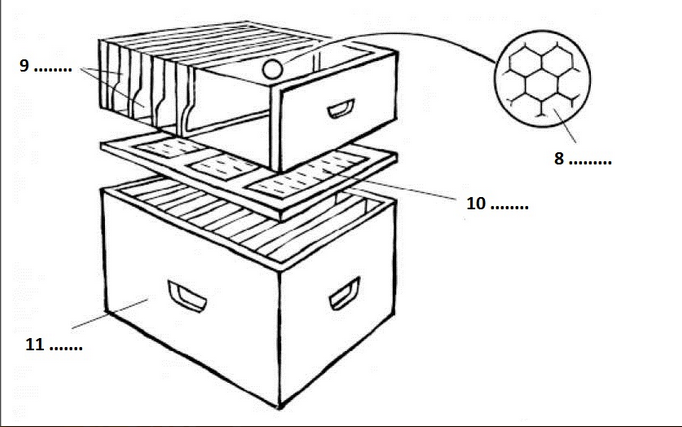
F. In their new location, the beekeeper will pay the farmer to allow his bees to feed in such places as orange groves. The honey produced here is fragrant and sweet and can be sold by the beekeepers. To encourage the bees to produce as much honey as possible during this period, the beekeepers open the hives and stack extra boxes called supers on top. These temporary hive extensions contain frames of empty comb for the bees to fill with honey. In the brood chamber below, the bees will stash honey to eat later. To prevent the queen from crawling up to the top and laying eggs, a screen can be inserted between the brood chamber and the supers. Three weeks later the honey can be gathered.
G. Foul smelling chemicals are often used to irritate the bees and drive them down into the hive’s bottom boxes, leaving the honey- filled supers more or less bee free. These can then be pulled off the hive. They are heavy with honey and may weigh up to 90 pounds each. The supers are taken to a warehouse. In the extracting room, the frames are lilted out and lowered into an “uncapper” where rotating blades shave away the wax that covers each cell. The uncapped frames are put in a carousel that sits on the bottom of a large stainless steel drum. The carousel is filled to capacity with 72 frames. A switch is flipped and the frames begin to whirl at 300 revolutions per minute; centrifugal force throws the honey out of the combs. Finally the honey is poured into barrels for shipment.
H. After this, approximately a quarter of the hives weakened by disease, mites, or an ageing or dead queen, will have to be replaced. To create new colonies, a healthy double hive, teeming with bees, can be separated into two boxes. One half will hold the queen and a young, already mated queen can be put in the other half, to make two hives from one. By the time the flowers bloom, the new queens will be laying eggs, filling each hive with young worker bees. The beekeeper’s family will then migrate with them to their summer location.
Adapted from “America's Beekeepers: Hives for Hire” by Alan Mairson, National Geographic.
Questions for Reading Passage: Migratory Beekeeping
Questions 1-7
The flow chart below outlines the movements of the migratory beekeeper as described in Reading Passage.
Complete the flow chart. Choose your answers from the box and write your answers in boxes 1-7 on your answer sheet.
BEEKEEPER MOVEMENTS
| Example |
| In February, Californian farmers hire bees to help Answer: polinate almond trees. |
| ↓ |
| In March, beekeepers 1__________ for migration at night when the hives are 2 _______ and the bees are generally tranquil. A little 3________ can ensure that this is the case. |
| ↓ |
| They transport their hives to orange groves where farmers 4_________ beekeepers for placing them on their land. Here the bees make honey. |
| ↓ |
| After three weeks, the supers can be taken to a warehouse where 5_______ are used to remove the wax and extract the honey from the 6_______ |
| ↓ |
| After the honey collection, the old hives are rejected. Good double hives are 7________ and re-queened and the beekeeper transports them to their summer base. |
LIST OF PHRASES/WORDS
| smoke | chemicals | pay |
| barrels | protection | charge |
| set off | light | split |
| pollinate | machine | supers |
| combs | screen | prepare |
| full | empty | queens |
Questions 8-11
Label the diagram below.
Choose ONE OR TWO WORDS from the Reading Passage for each answer.
Write your answers in boxes 8-11 on your answer sheet.
A BEEHIVE
Questions 12-15
Do the following statements agree with the information given in Reading Passage? In boxes 12-15 write.
YES: if the statement agrees with the information given
NO: if the statement contradicts the information given
NOT GIVEN: if there is no information about this
12. The Egyptians keep bees on the banks of the Nile.
13. First attempts at migratory beekeeping in America were unsuccessful.
14. Bees keep honey for themselves in the bottom of the hive.
15. The honey is spun to make it liquid.
Premium IELTS Coaching
at an Affordable Price
Answers of Migratory Beekeeping Reading Passage with Explanations
Let us know the explanations of ‘Migratory Beekeeping Reading Answers’. This will help you know the reasons for the mentioned solutions.
Question 1
Question 2
Question 3

Unlock All Explanations for Free
Question 4
Question 5
Question 6
Question 7
Question 8
Question 9
Question 10
Question 11
Question 12
Question 13
Question 14
Question 15

IELTS Prep Boost
Unlimited Access Includes
Other Passages
Important Links for IELTS Exam
Explore Free IELTS Mock Tests
Find IELTS Coaching Centres
Practice Every IELTS Module
Essential IELTS Tools & Resources
Study Abroad Consultants in India
Top Study Abroad Destinations
Exams Required to Study Abroad
Popular Universities to Study Abroad
Important Links for IELTS Exam
Explore Free IELTS Mock Tests
Find IELTS Coaching Centres
Practice Every IELTS Module
Essential IELTS Tools & Resources
Study Abroad Consultants in India
Top Study Abroad Destinations
Popular Universities to Study Abroad
Quick Links
The above passage talks about beekeeping and the various experiments done by the beekeepers. Many important facts are mentioned from the blooming seasons to paying the farmers. The honey is made when the beekeepers let their bees be on the orange groove. It also talks about many experiments by Egyptians and Americans. Out of these, few were successful and others were a failure. Towards the end, bee breeding is mentioned.
However, this was one such passage. There are hundreds of IELTS reading passage available on the website. You can explore the resource centre of the IELTS module. However, if you want to furbish your skills, then you can enrol in online IELTS classes. Below are the tips that you can follow to ace the exam in the first attempt.
Tips to Ace the Reading Passage on “Migratory Beekeeping”
- Identify the Question Types: It is important for the candidate to understand the question type before attempting the exam. This will help you to answer the question easily.
- Understand the Concept: The candidate must understand the concept of the reading passage instead of the meaning of each word.
- Attempt All the Questions: The candidate must attempt all the questions. They can make a wise guess since there is no negative marking in the exam.
Types of Question in This Reading Passage
There are 14 types of questions that appear in the IELTS Academic exam. You should have prepared all the types of questions before attempting the official exam. In the passage “Migratory Beekeeping”, the candidate came across three different types of questions. These are mentioned below:
Flowchart Completion Questions
The questions 1-7 were the IELTS academic reading flow chart completion question type. It allows you to fill the gaps in a flow chart using correct words taken from the paragraph. But in these, you have to choose the right word from the box. The candidate has to read the given passage first and then look for the blank spaces in the flow chart. In IELTS Academic Reading, flow chart completion question types restrict your word limits by giving ‘NO MORE THAN THREE WORDS’ or ‘ONLY TWO WORDS’ from the passage. If you don’t adhere to instructions, your answers will become incorrect.
Diagram Labelling Questions
The question 8-11 were answered on the basis of the given diagram. In this task type, the candidate has to fill in the missing label in the diagram from the IELTS reading passage. However, the clear instructions to answer will be mentioned like, 'NO MORE THAN THREE WORDS AND/OR A NUMBER from the passage,' 'ONE WORD ONLY,' or 'NO MORE THAN TWO WORDS.
This question type assesses your ability to comprehend the given visual representations. If you want to improve your ability to solve these kinds of questions, you can sign up for the IELTS reading practice test today.
Yes No Not Given Questions
The questions 12-15 of the IELTS reading passage “Migratory Beekeeping” were the yes no not given type questions. A set of statements were given on the basis of the passage and the candidate has to mention whether it is agreeing or disagreeing. You have to answer in ‘Yes’ if the statement agrees with the information, answer ‘no’ if it does not agree, it is 'No', and if the statement is not given in the entire reading paragraph, then it is 'Not Given'. The answers and statements will be in same order to ease out your work.
To sum up, you need to practice the IELTS reading questions. Of course, with migratory beekeeping reading answers and many other topics that are mentioned on the website will help you get a gist of how to clear the reading section with a good IELTS band score. Go through all the topics to know which all question types you can get in IELTS reading.
