
Reed Bed Reading Answers with Explanation
The following answers of reed bed reading passage will make you familiar with the IELTS reading section. You can practice by writing down the complex words given in the passage and examining how they relate to the questions. It will enhance your reading comprehension and broaden your English language fluency. So, use the below passage to improve your reading ability. Moreover, the ideal time to solve the write-up is 20 minutes.
So, let us see if you can answer and understand the paragraph within the given time.
IELTS Prep Boost
Elevate your preparation with exclusive tools
Unlimited Access Includes
BEST PLANDuration Days
IELTS Reading Passage: Reed Bed
Paragraph- 1
In recent years, it has been shown that plants, more accurately roots, play a crucial part in purifying dirty water before it enters seas and rivers. In 15th-century Britain, dirty water was purified by passing through the wetlands. People began to realize that the “natural” way of water purification was effective. Nowadays subsurface flow wetlands (SSFW) are a common alternative in Europe for the treatment of wastewater in rural areas, Mainly in the last 10 to 12 years there has been a significant growth in the number and size of the systems in use. The conventional mechanism of water purification used in big cities where there are large volumes of water to be purified is inappropriate in rural areas.
Paragraph- 2
The common reed has the ability to transfer oxygen from its leaves, down through its stem and rhizomes, and out via its root system. As a result of this action, a very high population of microorganisms occurs in the root system, in zones of aerobic, anoxic, and anaerobic conditions. As the wastewater moves very slowly through the mass of reed roots, this liquid can be successfully treated. The reason why they are so effective is often because within the bed’s root sector, natural biological, physical, and chemical processes interact with one another to degrade or remove a good range of pollutants.
Paragraph- 3
Dirty water from households, farms, and factories consumes a lot of oxygen in the water, which will lead to the death of aquatic creatures. Several aquatic plants are important in purifying water. They not only absorb carbon dioxide and release oxygen into the water, improving the environment for fish but absorb nutrients from the welter as well. Britain and the G.S. differ in their preference for plants to purify water. Bulrushes (Scirpus spp.) and rushes (Juncus spp.) are excellent water purifiers. They remove excess nutrients from the water as well as oil and bacteria such as Escherichia coli and Salmonella. However, algae grow freely in summer and die off in winter. Their remains foul the bottom of the pool.
Paragraph- 4
Artificial reed beds purify water in both horizontal and downflow ways. The reeds succeed best when a dense layer of root hairs has formed. It takes three years for the roots to fully develop. Which type of wetland a certain country applies varies widely depending on the country in Europe and its main lines of development. Besides the development of horizontal or vertical flow wetlands for wastewater treatment, the use of wetlands for sludge treatment has been very successful in Europe. Some special design lines offer the retention of microbiological organisms in constructed wetlands, the treatment of agricultural wastewater, the treatment of some kinds of industrial wastewater, and the control of diffuse pollution.
Paragraph- 5
If the water is slightly polluted, a horizontal system is used. Horizontal-flow wetlands may be of two types: free-water surface-flow (FWF) or sub-surface water-flow (SSF). In the former the effluent flows freely above the sand/gravel bed in which the reeds etc. are planted; in the latter effluent passes through the sand/gravel bed. In FWF-type wetlands, effluent is treated by plant stems, leaves, and rhizomes. Such FWF wetlands are densely planted and typically have water depths of less than 0.4m. However, dense planting can limit the diffusion of oxygen into the water.
Paragraph- 6
These systems work particularly well for low-strength effluents or effluents that have undergone some form of pre-treatment and play an invaluable role in tertiary treatment and the polishing of effluents. The horizontal reed flow system uses a long reed bed, where the liquid slowly flows horizontally through. The length of the reed bed is about 100 meters. The downside of horizontal reed beds is that they use up lots of land space and they do take quite a long time to produce clean water.
Paragraph- 7
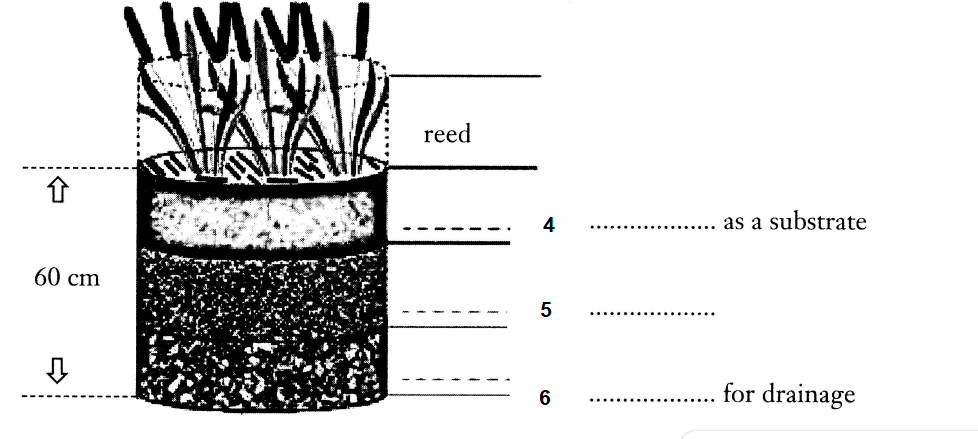
A vertical flow (downflow) reed bed is a sealed, gravel-filled trench with reeds growing in it. The reeds in a downflow system are planted in a bed 60cm deep. In vertical flow reed beds, the wastewater is applied to the top of the reed bed, flows down through a rhizome zone with sludge as a substrate, then through a root zone with sand as a substrate, followed by a layer of gravel for drainage, and is collected in an under drainage system of large stones. The effluent flows onto the surface of the bed and percolates slowly through the different layers into an outlet pipe, which leads to a horizontal flow bed where it is cleaned by millions of bacteria, algae, fungi, and microorganisms that digest the waste, including sewage. There is no standing water so there should be no unpleasant smells.
Paragraph- 8
Vertical flow reed bed systems are much more effective than horizontal flow reedbeds not only in reducing biochemical oxygen demanded (BOD) and suspended solids (SS) levels but also in reducing ammonia levels and eliminating smells. Usually considerably smaller than horizontal flow beds, they are capable of handling much stronger effluents that contain heavily polluted matters and have a longer lifetime value. A vertical reed bed system works more efficiently than a horizontal reed bed system, but it requires more management, and its reed beds are often operated for a few days and then rested, so several beds and a distribution system are needed.
Paragraph- 9
The natural way of water purification has many advantages over the conventional mechanism. The natural way requires less expenditure for installation, operation, and maintenance. Besides, it looks attractive and can improve the surrounding landscape. Reed beds are natural habitats found in floodplains, waterlogged depressions, and estuaries. The Natural bed systems are a biologically proven, environmentally friendly, and visually unobtrusive way of treating wastewater, and have the extra virtue of frequently being better than mechanical wastewater treatment systems. Over the medium to long term, reed bed systems are, in most cases, more cost-effective to install than any other wastewater treatment. They are naturally environmentally sound protecting groundwater, dams, creeks, rivers, and estuaries.
Question for Reading Passage: Reed Bed
Questions 1-3
Do the following statements agree with the information given in Reading Passage?
In boxes 14-16 on your answer sheet, write
TRUE if the statement agrees with the information
FALSE if the statement contradicts the information
NOT GIVEN if there is no information on this
1. The reed bed system is a conventional method for water treatment in urban areas.
2. In the reed roots, there is a series of processes that help break down the pollutants.
3. Escherichia coli is the most difficult bacteria to eliminate.
Questions 4-6
Complete the diagram below.
Choose NO MORE THAN THREE WORDS from the passage for each answer.
Questions 7-11
Use the information in the passage to match the advantages and disadvantages of the two systems: horizontal flow system and down-flow system (listed A—H) below.
Write the appropriate letters A-H in boxes 7-11 on your answer sheet.
The advantage of the downflow system is __7___; however, __8__ and __9__. The two advantages of the horizontal system are __12__ and __11__ In comparison with the downflow system, the horizontal system is less effective.
| A. it requires several beds |
| B. it is easier to construct |
| C. it builds on a gradient |
| D. it doesn’t need much attention |
| E. it produces less sludges |
| F. it isn’t always working |
| G. it needs deeper bed |
| H. it can deal with more heavily polluted water |
Questions 12-13
Choose two correct letters, from the following A, B, C, D, or E
Write your answers in boxes 12-13 on your answer sheet
What are the two benefits of natural bed systems when compared to conventional systems?
A. They have good aesthetics and are environmentally friendly.
B. Neither fuel nor electricity is needed for operation.
C. They are intended to reduce expenses associated with installation and operation.
D. There are no mechanical systems involved.
E. They don't collapse.
Premium IELTS Coaching
at an Affordable Price
Answers of Reed Bed Reading Passage with Explanation
Read below to get the answers of reed bed passage along with locations and explanations.
Question 1
Question 2
Question 3

Unlock All Explanations for Free
Question 4
Question 5
Question 6
Question 7
Question 8
Question 9
Question 10
Question 11
Question 12
Question 13

IELTS Prep Boost
Unlimited Access Includes
Other Passages
Important Links for IELTS Exam
Explore Free IELTS Mock Tests
Find IELTS Coaching Centres
Practice Every IELTS Module
Essential IELTS Tools & Resources
Study Abroad Consultants in India
Top Study Abroad Destinations
Exams Required to Study Abroad
Popular Universities to Study Abroad
Important Links for IELTS Exam
Explore Free IELTS Mock Tests
Find IELTS Coaching Centres
Practice Every IELTS Module
Essential IELTS Tools & Resources
Study Abroad Consultants in India
Top Study Abroad Destinations
Popular Universities to Study Abroad
Quick Links
The above passage discusses the effectiveness of red beds and wetlands in naturally purifying wastewater. It also highlights the advantages of using flow wetlands (SSFW) and differentiates between horizontal and vertical reed bed systems. The above write-up explains how this system works, its efficiency, and environmental benefits compared to traditional water purification procedures. Moreover, vertical flow reed beds are noted for their higher efficiency in reducing pollutants and odors, as they require more management.
Moreover, to find the answers of reed bed reading passage, consider adopting effective strategies like skimming to grasp the main idea and scanning for specific details. However, regular practice with the IELTS reading mock test and exposure to many question types will sharpen your skills for exam day.
Tips to Excel The Reading Passage on "Reed Bed"
Below are some tips to help you in solving the answers of reed bed easily. So, read the following tips to boost your reading abilities:
- True/ False/ Not Given: Use the skimming techniques to comprehend the gist of the passage.
- Diagram Labeling: Look at the parts to be labeled and decide what type of details are needed for the blank.
- Matching Features: The question will not be in progressive order, so do not search in that manner.
- Multiple Choice: Get the right answer by matching the meaning rather than matching the words.
Types of Questions in this Reading Passage
This answers of reed bed reading passage has four types of questions. Let us understand and discuss each of them in detail.
True/ False/ Not Given (1-3)
In this type of question, you are presented with a statement and your task is to determine if it agrees with the details in the passage (True), contradicts the details in the passage (False), or if there is insufficient data in the passage to decide (Not Given).
Diagram Labeling (4-6)
In this type of question, you are presented with a diagram, chart, graph, and more, often related to a specific topic or subject area. The diagram is typically accompanied by a list of labels or terms that are missing from the diagram. You are needed to match the correct labels to the corresponding parts of the images.
Matching Features (7-11)
In this type of question, you typically need to pair related items based on certain criteria. This could involve comparing characteristics, identifying connections, or linking items that complement each other. This specific approach will depend on the task context.
Multiple Choice (12-13)
In this type of question, you will be presented with a question followed by a set of options from which you must select an answer. Typically there are three or four options to choose from. You must carefully read the question and each option before selecting the right answer.
These were the question types you have gone through of the reed bed reading answers. Moreover, if you want to enhance your confidence level in the examination, you should enroll in offline or online IELTS coaching to improve your skills in English.
