
Sunset for the Oil Business Reading Answers with Explanations
You can ace the IELTS toughest reading section easily with no more obstacles. Do you know, how? Well, you can start reading the answers of sunset for the oil business reading passage. This is one of the best ways to improve your scoring and reduce issues.
Also, test takers will get the solutions with explanations to understand better. So, let us first begin with reading the text.
IELTS Prep Boost
Elevate your preparation with exclusive tools
Unlimited Access Includes
BEST PLANDuration Days
IELTS Reading Passage: Sunset for the Oil Business
The world is about to run out of oil. Or perhaps not. It depends on whom you believe…
Paragraph- A
Members of the Department Analysis Centre (ODAC) recently met in London and presented technical data that support their grim forecast that the world is perilously close to running out of oil. Leading lights of this moment, including the geologist Colin Campbell, rejected rival views presented by the American Geological Survey and the International Energy Agency that contradicted their findings. Dr. Campbell even decried the amazing display of ignorance, denial, and obfuscation by the government, industry, and academics on this topic.
Paragraph- B
So is the oil really running out? The answer is easy: Yes. Nobody seriously disputes the notion that oil is, for all practical purposes, a non-renewable resource that will run out someday, be that years or decades away. The harder question is determining when precisely oil will begin to get scarce. And answering that question involves scaling Hubbert’s peak.
Paragraph- C
M. King Hubbert, a Shell geologist of legendary status among depletion experts, forecast in 1956 that oil production in the United States would peak in the early 1970s and then slowly decline, in something resembling a bell-shaped curve. At the time, his forecast was controversial, and many rubbished it. After 1970, however, empirical evidence proved him correct: oil production in America did indeed peak and has been in decline ever since.
Paragraph- D
Dr Hubbert’s analysis drew on the observation that oil production in a new area typically rises quickly at first, as the easiest and cheapest reserves are tapped. Over time, reservoirs age and go into decline, and so lifting oil becomes more expensive. Oil from that area then becomes less competitive in relation to other fuels, or to oil from other areas. As a result, production slows down and usually tapers off and declines. That, he argued, made for a bell-shaped curve.
Paragraph- E
His successful prediction has emboldened a new generation of geologists to apply his methodology on a global scale. Chief among them are the experts at ODAC, who worry that the global peak in production will come in the next decade. Dr Campbell used to argue that the peak should have come already; he now thinks it is just around the corner. A heavyweight has now joined this gloomy chorus. Kenneth Deffeyes of Princeton University argues in a lively new book (“The View from Hubbert’s Peak”) that global oil production could peak as soon as 2004.
Paragraph- F
That sharply contradicts mainstream thinking. America’s Geological Survey prepared an exhaustive study of oil depletion last year (in part to rebut Dr Campbell’s arguments) that put the peak of production some decades off. The IEA has just weighed in with its new “World Energy Outlook”, which foresees enough oil to comfortably meet the demand to 2020 from remaining reserves. René Dahan, one of ExxonMobil’s top managers, goes further: with an assurance characteristic of the world’s largest energy company, he insists that the world will be awash in oil for another 70 years.
Paragraph- G
Who is right? In making sense of these wildly opposing views, it is useful to look back at the pitiful history of oil forecasting. Doomsters have been predicting dry wells since the 1970s, but so far the oil is still gushing. Nearly all the predictions for 2000 made after the 1970s oil shocks were far too pessimistic. America’s Department of Energy thought that oil would reach $150 a barrel (at 2000 prices); even Exxon predicted a price of $100.
Paragraph- H
Michael Lynch of DRI-WEFA, an economic consultancy, is one of the few oil forecasters who has got things generally right. In a new paper, Dr Lynch analyses those historical forecasts. He finds evidence of both bias and recurring errors, which suggests that methodological mistakes (rather than just poor data) were the problem. In particular, he faults forecasters who used Hubbert-style analysis for relying on fixed estimates of how much “ultimately recoverable” oil there really is below ground, in the industry’s jargon: that figure, he insists, is actually a dynamic one, as improvements in infrastructure, knowledge, and technology raise the amount of oil which is recoverable.
Paragraph- I
That points to what will probably determine whether the pessimists or the optimists are right: technological innovation. The first camp tends to be dismissive of claims of forthcoming technological revolutions in such areas as deep-water drilling and enhanced recovery. Dr Deffeyes captures this end-of-technology mindset well. He argues that because the industry has already spent billions on technology development, it makes it difficult to ask today for new technology, as most of the wheels have already been invented.
Paragraph- J
Yet techno-optimists argue that the technological revolution in oil has only just begun. Average recovery rates (how much of the known oil in a reservoir can actually be brought to the surface) are still only around 30-35%. Industry optimists believe that new techniques on the drawing board today could lift that figure to 50-60% within a decade.
Paragraph- K
Given the industry’s astonishing track record of innovation, it may be foolish to bet against it. That is the result of adversity: the nationalizations of the 1970s forced Big Oil to develop reserves in expensive, inaccessible places such as the North Sea and Alaska, undermining Dr Hubbert’s assumption that cheap reserves are developed first. The resulting upstream investments have driven down the cost of finding and developing wells over the last two decades from over $20 a barrel to around $6 a barrel. The cost of producing oil has fallen by half, to under $4 a barrel.
Paragraph- L
Such miracles will not come cheap, however, since much of the world’s oil is now produced in aging fields that are rapidly declining. The IEA concludes that global oil production need not peak in the next two decades if the necessary investments are made. So how much is necessary? If oil companies are to replace the output lost at those aging fields and meet the world’s ever-rising demand for oil, the agency reckons they must invest $1 trillion in non-OPEC countries over the next decade alone. That’s quite a figure.
Questions for Reading Passage: Sunset for the Oil Business
Questions 1-5
Look at the following statements (questions 10-14) and the list of people below.
Match each statement with the correct person, A-E.
Write the correct letter, A-E in boxes 10-14 on your answer sheet.
NB You may use any letter more than once.
| List of People |
| Colin Campbell |
| M. King Hubbert |
| Kenneth Deffeyes |
| Rene Dahan |
| Michael Lynch |
1. .................... has found fault in the geological research procedure
2. ..................... has provided the longest-range prediction regarding oil supply
3. ..................... has persuaded others that oil production will follow a certain model
4. ..................... has accused fellow scientists of refusing to see the truth
5. ..................... has expressed doubt over whether upgrade methods of extracting oil are possible.
Questions 6-9
Complete the notes below
Choose ONE WORD ONLY from the passage for each answer.
Write your answers in boxes 6-9 on your answer sheet.
6. Many people believed Hubbert’s theory was 6_______ when it was originally presented.
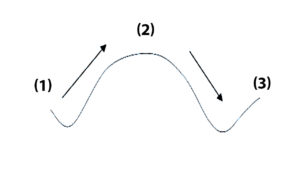
(1) When an oilfield is 7________ it is easy to…
(2) The recovery of the oil gets more 8 _________ as the reservoir gets older
(3) The oilfield can’t be as 9_________ as other areas.
Questions 10-14
Do the following statements agree with the claims of the writer in Reading Passage?
In boxes 1-5 on your answer sheet, write
YES- if the statement agrees with the information
NO- if the statement contradicts the information
NOT GIVEN- if there is no information on this
10. Hubbert has a high-profile reputation amongst ODAC members.
11. Oil is likely to last longer than some other energy sources.
12. The majority of geologists believe that oil with start to run out sometime this decade.
13. Over 50 percent of the oil we know about is currently being recovered.
14. History has shown that some of Hubbert’s principles were mistaken.
Premium IELTS Coaching
at an Affordable Price
Answers of Sunset for the Oil Business Reading Passage with Explanations
It may be tough to find sunset for the oil business reading answers. That is why, here are the solutions for your convenience. You can analyze and practice whenever you want.
Question 1
Question 2
Question 3

Unlock All Explanations for Free
Question 4
Question 5
Question 6
Question 7
Question 8
Question 9
Question 10
Question 11
Question 12
Question 13
Question 14

IELTS Prep Boost
Unlimited Access Includes
Other Passages
Important Links for IELTS Exam
Explore Free IELTS Mock Tests
Find IELTS Coaching Centres
Practice Every IELTS Module
Essential IELTS Tools & Resources
Study Abroad Consultants in India
Top Study Abroad Destinations
Exams Required to Study Abroad
Popular Universities to Study Abroad
Important Links for IELTS Exam
Explore Free IELTS Mock Tests
Find IELTS Coaching Centres
Practice Every IELTS Module
Essential IELTS Tools & Resources
Study Abroad Consultants in India
Top Study Abroad Destinations
Popular Universities to Study Abroad
Quick Links
From the above sunset for the oil business reading answers, you have an idea for the question types and solutions as well. Besides, this write-up talks about the oil business that is going to run out in the next few years. For that, there are several factors presented through the A to L paragraphs. As per the writer's view, in the next 70 years, these businesses will overall out from Earth.
To achieve the highest scores in exams, every test taker needs good practice and prep. Similarly, in the IELTS reading section, it can be done by either taking passages or a free IELTS reading mock test. An interesting thing is, that you do not have to look anywhere for them, just connect with Gradding.com. Here, you will get all the required material to rehearse for this exam within a few minutes.
Tips to Ace Sunset for the Oil Business Reading Answers
If you want to ace sunset for the oil business reading answers with locations, you must refer to the below tips.
- To tackle the matching features type of questions, try to identify the key aspects for each task. Further, scan them in all paragraphs to finalize the correct response.
- When students attempt note-completion tasks, they have to understand the viewpoint of the writer. For that, they need to first skim the text and analyze its main idea.
- When test takers attempt, Yes/No/Not Given tasks, they need to pay attention to specific details of the text. For that, they can start first by reading the passage carefully.
Types of Questions in This Reading Passage
The above write-up of sunset for the oil business reading answers covers three types of tasks. From the following info, you will get details for each.
Matching Features (1-5)
The matching features type of questions are based on specific details. Also, these details are taken from the passage. You have to identify from which paragraph it is and identify the connections.
Note Completion (6-9)
You will get some blanks in note-completion tasks. You have to fill in the missing information, after reading the complete passage carefully. These tasks are specially designed to assess the ability to understand detailed info.
Yes /No /Not Given (10-14)
You will get straightforward sentences for these questions. Test takers have to agree with them and write:
- Yes, if the given question is correct according to the text.
- No, if they find the details incorrect.
- Not Given, when they do not see anything regarding the task.
Conclusion
You have gone through the answers of sunset for the oil business reading passage. With this, students have an idea of how to tackle its tasks. Along with this, if you want to practice more skills like listening, writing, or speaking, you can take online IELTS coaching, provided by Gradding.com. With our best trainers, you can enhance your overall skills required for this exam easily.
